|
ENGAGEMENT
AND THE 21ST CENTURY
NEWSROOM:
THE
FOUR
PHASES OF EDITORIAL VOICE
(AND
FOUR .CRAZY. IDEAS FOR FINDING
THEM)
(available
from: http://www.mediagiraffe.org/voice
)
Version 2.0 March 8, 2008
This is an edited and expanded version of remarks by Bill Densmore, director
of
the Media Giraffe Project
at
the University of Massachusetts Amherst, delivered on Sunday, March 2,
2008, to
a meeting of approximately 30 U.S. newspaper editorial writers and others
at
the Westin Bonaventure Hotel, in Los Angeles as part of the four-day
seminar, .Best
Practices: Editorial and Commentary in Cyberspace,. presented by the
Knight
Digital media Center of the USC Annenberg School for Communication in
partnership with the National Conference of Editorial
Writers.
Thank-you to Vikki (Porter)
and
to Michael (Williams) for the opportunity to engage with you this
evening.
This text is available at
http://www.mediagiraffe.org/voice
Twelve years ago, I gave a talk in San Francisco at
an
interactive newspapers convention and I said something, which ended up
quoted
in The New York Times. I said I felt that trying to be a
pundit and
advise editors on the Internet was .kind of like the blind leading the
blind..
I still have that feeling. The speed at which
technology
is changing what you do, and what I used to do, is only accelerating. As
an
industry, newspapers adjusted pretty well to the transition from Linotypes
to
Linotronics to DEC to paste-ups and then pagination. The waves of change
came
more slowly. That.s changed. Two years ago, if I said .social network.
most of
us wouldn.t have understood what I was talking about. Now we know that
refers
to YouTube, Facebook, Ning, Tribe.net, MySpace . just to scratch the
surface.
All of this produces anxiety. What do we need to
learn, or
try, next? The only certainty is that we must keep learning, and keep
trying,
or be left behind. In that context, let me propose some changes in the way
editorial pages are put together and in the way we define their voice . or
voices.
I did over the last week something akin to what you
all
will more and more be doing. I reached out to my own .social
network.. I sent emails to some 20 advisors and
friends, and more than 15 responded.
I
figure on speaking for about 30 minutes. And then I.d like to moderate a
discussion about some of the ideas that these respondents and I raise. I.m
sure
many of those ideas will not be new to you (we discussed a couple this
afternoon). Some of you may already be trying them in your own shops, and
you
will want to continue to share tips about that learning and trying over
the
next three of days.
So in this talk, I.m going to begin by summarizing
the
views of some key observers on the news organization.s emerging role as
what I
would call a .director of community engagement.. Then I.ll lay out what
we.ll
call the four phases of editorial voice.
Then I.ll give some examples from some of my 15 respondents of
things
you can do to adopt one or more of those voices. Finally, I.ll finish with
what
we.ll call four crazy ideas to ignite a useful discussion.
PARTICIPATORY CULTURE AND THE NEWS SOCIAL NETWORK
MIT Prof. Henry Jenkins, in his 2007 book, Convergence Culture: Where Old and New
Media
Collide, popularizes the idea that information technology -- the
ability of
the network to allow real-time exchange among multiple people physically
removed from each other (with
serious
games and other applications) . is creating a new sort of participatory
culture. What voice in this new
culture
is appropriate for the news organization . I am not going to say
newspaper
in this talk because the newspaper is now just one output product not the core service.
You are all in
a
service business.
The Poynter Institute-sponsored Online-news list
serve
carried a rich series of exchanges last week that are on the point of news
organizations building local community.
(A summary of some of the
exchanges is APPENDED to this paper.) I.ll post a longer version of
this
talk on the web, which includes some discussion of the discussion. What folks like Steve Yelvington, Roy
Clark, Rich Gordon and others are saying:
The new news role is as an organizer/convener of conversations,
that
sociologists like author Robert Putnam (Bowling Alone) find a tight
relationship between news readership and strong community and . this is
the
most important point . it.s time for news organizations to go back to
their 19th
century origin of taking on community-building as a personal and
institutional
mission. The phrase du jour for expressing that:
Building
social capital.
ENGAGEMENT .
THE
FOUR PHASES OF EDITORIAL VOICE
Some of you may now be thinking: How do I figure out the roles I need to play in this new
world of
community engagement. Here.s where
I.d
like to offer for consideration .the four phases of editorial voice.. I.m
going
to suggest that we have four ways of serving news-hungry consumers
available to
us.
The first role of the 21st century
news-sharing
organization is to act as a navigator.
The fiber optic cable and Moore.s Law of accelerating
microprocessor
power have combined to all but eliminate the physical .pinch point. that
limited the flow of information in modern society. That pinch-point was
the
printing press, or limited broadcast frequencies. And so the editor.s role is less and less defined by
choosing
which information to leave out, and more and more by what information to
highlight. Now most of you are probably struggling with a shrinking news
hole.
But that is a vestige of just one medium.
It does not seem likely that the cost of bandwidth will seriously
constrain the Internet anytime soon . if ever.
So now the key job is navigator . helping your participant users
just to
find what they need in order to be informed, participatory
citizens.
The second role of the 21st century
news-sharing organization is to act as an information
valet. No, not the fellow who parks your car; more like the
trusted advisor to an Enlightenment era
European king, or maybe the concierge in a fine hotel. The valet, or concierge, doesn.t make
a
product; he or she provides a service, the most trusted, personalized sort
of
service. And that.s a fundamental
change in thinking . from making a product . the newspaper . to providing
a
service . the trusted, customized information home base for your readers,
users, viewers and listeners.
The third role of the 21st century
news-sharing
organization is that of a referee. Your customers no longer merely
consume the news; they create it as well, with their blog, their cell
phone and
their Flickr, MySpace Facebook or Nonpublic pages. Where once your role was to arbitrate what ideas reached the
public sphere via your pages, now management of the information public
sphere
is done by the public itself. You can watch the cacophony and help players to find
constructive roles. You can take note of off sides, illegal touching and
rule
infractions (where rules exist!)
in the
discussion. It.s a critical role,
and
one you are institutionally suited to play.
I should at this point offer a credit and citation to
Michael Oreskes, executive editor of the International Herald
Tribune,
who spoke on
Oct. 19, 2007 to the Online
News
Association annual convention in Toronto.
In his remarks, he said: .Our authority and credibility used to
come
from our exclusivity and our control over the sources and distribution of
information. In the future it may come just as much from our transparency
and
our willingness to interact with our audiences. In this new world, we are
no
longer gatekeepers. So what shall we become? Guides, perhaps? Color
commentators? Referees? That
question
alone could keep our discussion going for some time. But whatever image we
adopt
for what we should become I think it is clear what we should NOT become.
We
must not be conveyor belts..
Let me talk a little bit about the notion of
editorialist
as referee of the conversations, too.
Maybe not locally, but certainly nationally, and
worldwide, there.s now much more opinion and many more data mashups and
undigested, undifferentiated facts. And perhaps I guess more analysis,
too. But
certainly there.s not more reporting. And so the unique value of the
editorialist is no longer merely the ability to offer opinion, but now it
has
to be differentiated opinion. And the differentiation it seems to me is in
adopting . one solution is to adopt more of an above-the-fray voice. Not
an
aloof voice, but a voice, which implies knowledge of and collaboration
with
many other voices at the level, if not necessarily at the grassroots
citizen,
level then at the next stage of the food chain up, which is the
blogosphere
now. This becomes the referee role.
Dale Peskin, a news-industry futurist with iFocos, posted Feb. 20, 2008 on
the
John S. and James L. Knight Foundation website blog, a link to the
BecauseItMatters.net community discussion of the Gulf Coast Community
Foundation. The foundation has posted
10 tips for civil dialog, which are a useful guide to the role of the
referee:
Navigator . . . valet . . . referee. While we may
come up
with better shorthand terminology tonight, I think the roles I.ve
described fit
within a generally accepted framework of the Rosenstiel-Kovach Elements
of Journalism ethical paradigms.
But I am going to go out on a limb and offer a fourth role. It.s
that of
a teacher/coach.
Memphis Commercial Appeal Editor Chris Peck put it
this
way in a paper delivered earlier to a NCEW session: .Editorial-page editors must be personalities, provocateurs
and
preachers for the First Amendment. They are alternately engaging and
inspiring
and always seeking community feedback. The words and opinions offered up
need
to be quickly and routinely critiqued by the community..
American newspapers and their editorial pages are no
longer the sole gatekeeper of the information commons in most
communities. In print, although perhaps not online,
their
reach is shrinking. There are alternatives online now, and there will be
more,
as the owners of TV, radio, print, Internet and mobile platforms all
converge. Since the 1930s, many
editors
accepted a .public trust. model to describe their stewardship of the
precious
and dominant print service. Most felt an obligation to . at least within a
certain range . reflect ideological balance and a somewhat neutral point
of
view in the news columns . and openness to diverse views on the editorial
pages. I am not suggesting that
news
organizations abandon impartial news coverage . that remains a vital
service.
What I.m saying is that the competitive and cultural landscape has changed
to
the point that users/participants now expect advice and counsel as they
form
opinions and take civic action.
My own view is that publishers who want to survive in
the
new participatory culture are going to have to revert back to the 19th-century form and be
willing
to coach and lead their users . openly . to active participation in civic
life,
in the discussions of the public sphere.
There is integrity in strong opinions strongly felt. In the navigator and valet role, you
can
continue to show your users the way to other points of view. As the referee, you can hone and
moderate
the opinion that you sponsor and pay for on your own websites and
pages. But somewhere, you ought to be
coaching,
too. Yes that implies taking a position.
Information consumers, because of the Internet, can pick the poison
when
it comes to advocacy and point of view.
I would argue that you can join in . as long as you do so
transparently
and independently of your news operation.
If you don.t spend some time in the coach role, you will miss out
on the
participatory culture.
Navigator, valet, referee, teacher/coach. These four terms form a continuum
starting
at relative detachment . . . the navigator . . . to advice . . . the
valet
. . . . to creating the playing field . . .
the referee . . . to building the community . . . the coach.
Four distinct voices. But all, I think necessary in series, not
parallel, in an era of virtual community.
Because the Internet has enabled a new layer of community.
Community
used to be physical -- or perhaps
topical. Now there is a virtual layer.
And that virtual layer, even in the largest newspaper, is capable
of
being accessed, managed and played with by editors, almost in the same way
that
I as a rural weekly editor was able to work directly with my community.
The navigator finds, the valet recommends, the
referee
connects and facilitates community. And the teacher/coach builds
community.
FINDING THE TOOLS
So what are the tools the editorialist can draw upon
to
adopt these new voices?
When speaking in any of the four voices, the
editorialist.s toolbox has changed. Where once the news organization had
more
in common with experts in its access to specialized information and data,
now
the public has caught up. Much of
the
factual grist the editorialist can summon is equally available to the
public via
the Internet. So now you have to
be prepared
to explain why you picked two sources out of the 10 available to muster an
argument. You add value by
assessing
the validity and authenticity of those sources.
So what are the tools the editorialist can draw upon
to
adopt these new voices?
First, let.s be explicit about the workspace where you should be
applying your tools.
ELEVEN IDEAS FOR
ADDING VOICE TO THE EDITORIAL PROCESS
1. George White and the Mexican readership
council
There are lots of
ways to study how your now-participatory
audience views what you.re doing. I asked Media Giraffe Project
advisory-board
member George White, from UCLA.s Center for Communications and Community,
to
describe the work he has been doing with readership councils. He suggested
creating an online readership council for the opinion page. Here is an
extensive report on an innovative council program at a chain of Mexican
newspapers. White.s center assigned the story and it's posted
on White.s C3 Online website . This approach to getting community
input can
be applied to digital opinion pages. Here's how:
2. John Rash and putting readers in the
lineup
In Minneapolis, John
Rash has worked at an advertising
agency for 25 years. He also lectures at the University of Minnesota
journalism
school, writes a column on the op/ed page of the Star Tribune, and has a weekday, five-minute commentary show
on the
CBS radio O&O. His idea: Put readers in rotation in the op/ed
lineup,
by inviting them into the some part of the editorial-formulation
process. You might think initially that having
an
.outsider. in the closed-door debate over the paper.s editorial voice may
stifle debate. But who really are the outsiders?
Rash.s idea has already been tried. Beth Lawton of
the
Newspaper Association of America reports in her Digital Edge Snapshop on the experience in New Hampshire of
the Nashua Telegraph. The daily enlisted the high school's
television-production class in video recording (and live-streaming!) the
editorial board's interview with all the presidential candidates through
the
newspaper's Web site. That report
is
here: http://tinyurl.com/38v2zj
Rash suggests giving
readers a .heads up. on the next
day.s editorial a day ahead of time . even the position you.re thinking
about
taking. .You could write in print and online, .here.s what we plan on
editorializing about online tomorrow..
Ask the audience for input.
This
is a step back from the LA Times open wiki experiment. You.re not inviting
the
public to write the editorial, but to inform the thinking that goes into
it
before it.s finished. Why didn.t
papers
do this 30 years ago? Because you couldn.t get that kind of real-time
participation other than via a phone call. Now you can, so why
not?
3.
The
streaming editorial visit
Rash says there.s an
opportunity to experiment with video
in many forms. How about videotaping or live streaming an editorial-board
meeting . . . an endorsement session . . . or a visiting with civic
activists
on an important public issue? The tools to do so are practically
free. What would be lost compared with the
added
point of engagement with the public?
Nash worries He worries a bit that some of the real honest
collegian but
contentious debate ion an editorial board meeting might be compromised
because
people don.t want to say anything politically incorrect on video. Would the resulting dialog be less
candid
and less free ranging? The only sure answer is to try it.
4. Nick Reville and the video
curator
Nick
Reville and a couple of high-school buddies from Worcester,
Mass., started a nonprofit called The
Participatory Culture Foundation and built a web
browser called .Miro., that it is designed to help a
user to
manage video feeds rather than text.
Reville.s goal was to create an environment where video syndication
can
occur without a central authority.
People such as Mitch Kapor, the founder of Lotus Development Corp.,
and
the Mozilla Foundation, which owns the Firefox browser, are contributors
to
Miro. Reville was one of the people from whom I sought advice on newspaper
editorial voice. He.s about 25. Reville says he.s
enthusiastic
about using the web to promote localism with such things as
EveryBlock.com,
OpenCongress.org, Flickr and the idea of geotagging. A couple of words of advice from Reville:
Find 20 or 30 of the best local blogs in your
circulation
area . or however many you can find . and get in touch with them . whether
text
or video. Link to the best of
their
posts in print and online. Invite
some
to do a guest blog or column. Magnify, them, says Reville, because they
are
likely to be some of the best thinkers in the community. Even consider posting comments on those
blogs. .When you insert yourself in the conversation,. says Reville, .you
become relevant to those online people..
The idea, says Reville, is to be in the position of curator of
local
resources. .The approach in
traditional
print journalism has been a closed loop,. concludes Reville. .But there is
a
chance to be a trusted source for recommendations on lots of external
content..
5. Sorting and creating letters . two ideas
Anther idea from Rash . the letter-data mash up. Why not organize what you know about
letters, so many of which now come in by email? Cache the zip code of the sender; tag the views expressed.
Over
time, you can develop a picture of how the geography of your users is
reflected
in their concerns as expressed in letters.
Ithaca.s Dianne Lynch, who I mention earlier, pointed
me
to an idea which takes the letter data mashup idea a step backward . to
encourage your users to create the letter in the first place. It.s an Open Source application called
.Vox
Pop. that University of Kansas students built as part of a
Knight-Foundation
funded Innovation Incubator project involving five college journalism
programs. It can add links to
every
news story or op/ed material on a news website (and can be printed in the
paper, too). Readers can click on
the
link and be taken to a page that lists all of the 'newsmakers' in the
story,
with their contact information, both electronic and snail mail, as well as
phone. Readers can click on the
box,
write a letter to their newsmaker or representative and send it -- no more
saying, "I'm going to write that guy a letter" and never getting
around to it. BUT just as
important,
says Lynch, a copy of that message goes to the editor.... so editors can
track
who's contacting their local officials and about what -- a measure of the
issues and concerns of the community in a dynamic and organic way.
LINKS ABOUT VOX POX:
http://www.news.ku.edu/2007/november/7/journalism.shtml
http://ehub.journalism.ku.edu/innovation/
http://newshare.typepad.com/mediagiraffe/2007/10/audio-students-.html
http://newshare.typepad.com/mediagiraffe/2007/10/video-students-.html
http://jschoolmichstate.blogspot.com/2007/06/innovation-incubator-launches-in-ithaca.html
http://newsideas.org/innovationincubators.html
6. Reaching immigrant, other communities
Every immigrant community has an immigrant
infrastructure
that helps people adjust when they arrive in the United States, says Campbell Mithun.s Rash. What about
reaching
out to the organizations, which drive that adjustment, asking for ongoing
comment on the first-generation experience?
Similarly, have you considered appearing on a music-station talk
show or
picked another community, literally and figuratively, that you don.t
normally
reach?
In Lawrence, Kansas,
Journal World Managing Editor Dennis Anderson invites
minority leaders into the paper twice a month to critique coverage and to
suggest stories or issues the paper needs to keep an eye on. He asked each participant to subscribe
to
the paper and to clip articles for discussion. He asks them to make a
one-year
commitment to participate. .This
was
valuable,. says Anderson. .Because try as we might, a white middle aged
editor
still sees the world through the eyes of a white middle aged editor, but
the
group can make your more sensitive to issues minorities care
about..
7. Chris Ridder and tech-related ways to foster more
participation
Ideas from Chris
Ridder,
a residential fellow at the Center for Internet and Society at Stanford
University
and a former journalist turned lawyer.
He litigates copyright and trademark issues in the public interest,
in
addition to engaging in academic research. His
advice:
ˇ
Blog your editorials, signed or unsigned, so that
readers
can add comments.
ˇ
Use http://www.twitter.com
( http://en.wikipedia.org/wiki/Twitter
) to send under-140-word teasers about your page content . perhaps the day
before they hit the street . to a network of Twitter users. Twittering describes the sending of
extremely short blogs across a special network.
ˇ
Invite users to generate content. Preferably, let
them own
the IP, too. CNN's http://www.iReport.com is an example. The network allows
users to
post unfiltered photos and video clips. A small percentage are then vetted
and
used by CNN on the cable network. The rest are left on the iReport.com
website.
The same approach could be taken with op/ed material and letters.
An example of the highly
interactive news website (from Rich Gordon):
The
Racine Journal Times (Lee Enterprises):
http://www.journaltimes.com
8. Scott Karp
and
Publish2.com
Commentary should be
written as if you are talking to a
group of people sitting in the same room as you, says Scott Karp, former
head
of interactive for The Atlantic Monthly and now a startup entrepreneur
with
Publish 2.0, a beta-stage platform for allowing journalists to share
source
links and stories. Karp says
editorials
should link to other editorials, discuss and acknowledge the opinions of
other
commentators -- that's one reason why the blogosphere is so dynamic while
the
newspaper editorial seems so static and stale by comparison. Bloggers
engage in
debate and conversation by linking to each other -- so should MSM
commentators.
The world of opinion has gotten very crowded and competitive. Newspaper
commentators and editorial writers also need to realize that they no
longer
have a monopoly on the dissemination of opinion -- the world of opinion
has
gotten very crowded and competitive. .The typical journalistic voice, even
for
commentary, is detached, aloof, writing from on high,. says Karp. .I think
the
key is to establish a sense of intimacy, as you would talking to someone
face
to face. You're only going to have a "conversation" if people
feel
like you are actually talking to them rather than at them. That's how the
best
blogs manage to get so many comments -- it actually feels like people are
talking to each other. So the difference is writing with a writer's voice
vs.
your actual voice..
9. Fabrice
Florin
. help for the valet . trusted news ratings
In the role of
information valet, or authenticator,
editors might review the work of Newstrust.net, a non-profit website which
helps the public to discover and promote quality journalism. Founder Fabrice
Florin, a former Macromedia and Apple executive who started out as a
television documentary producer, lists principles which could be adopted
by
newspaper editorial-page editors to guide their work of discovering and
recommending quality comment and news to their readers. The ratings parameters at NewsTrust
include:
ˇ
Recommendation: Is it a good story?
ˇ
Trust: Do you trust this publication?
ˇ
Information: Is this story informative?
ˇ
Fairness: Is this story fair?
ˇ
Sources: Is this story well sourced?
ˇ
Context: Does this story show the "big
picture"?
More Ratings:
ˇ
Importance: Is this an important topic?
ˇ
Balance: Does this story present all key viewpoints?
ˇ
Style: Is this story well presented?
ˇ
Your Knowledge: Do you know about this topic?
ˇ
Accuracy: Is this story accurate?
At this point, many of you are probably a bit
overwhelmed.
You.re thinking, .How am I going to find the time to engage communities in
all
these new ways, when I still have to write a daily editorial, edit the
syndicated columnists, layout the daily pages and still have time to read
and
stay expert on the news? I think
there
are at least two answers to that question.
I.ll let Brad Stenger speak to one of them, and the other will be
one of
the crazy ideas we should discuss.
10. Brad Stenger . envisioning the news machine
Brad Stenger works for Wired Magazine. He and a team
of
about five other people organize an annual technology fair called .Wired NextFest.. this year it will
be in
Chicago . which attracts tens of thousands of visitors who want to learn
about
the newest inventions, systems,
networks, gadgets and gizmos in information technology and technology
generally. Brad has a graduate computer-science
degree
from George Tech and he just co-convened a 150-person gathering in Atlanta
.
co-sponsored by Yahoo, Google and others . entitled .Symposium
on Computation + Journalism.. The
premise . and this is also the premise of our NewsTools2008 gathering . is
that
journalists need to reach out to technologists. Together, they need to
create
the next generation of tools that will expand the ways journalists can be
assisted by computers . to let the machines do some of the work of culling
and
comparing of multiple data sources . so the journalists have more time to
analyze the results, to think and write and give voice to what all the
data
means.
Stenger outlined in an email to me his vision of a
.computational editorial writer..
We.ll
call this the CEW. He says the CEW will rely on a machine (not literally, but machine in the
sense of
a collection of computer-driven resources). That machine will support
research
required and helps to produce material in the volume and quality expected
for
an editorial page. To understand
what
he means, he suggests looking at:
http://www.everyblock.com ,
developed by Adrian
Holovaty -- where the local data streams are collected and where
possible
summarized and visualized. But that's only good for a coarse
overview.
ˇ
You get a little closer by adding to the machine the
voices in the community who blog and have RSS
feeds.
ˇ
And for those voices who don.t blog, you construct a Google search on key
identifiers of those local VIPs, and then use the Google-generated RSS
feed of
that search to create an active source of intelligence about that person,
or
local issue.
ˇ
The CEW.s machine should also track what's written on
editorial pages in peer communities whether local, national, or
international.
If there's no RSS feed to tap those sources, it'll still be worth the work
to
screen scrape those sources and format it into RSS. That way all those
sources
can be accessed together.
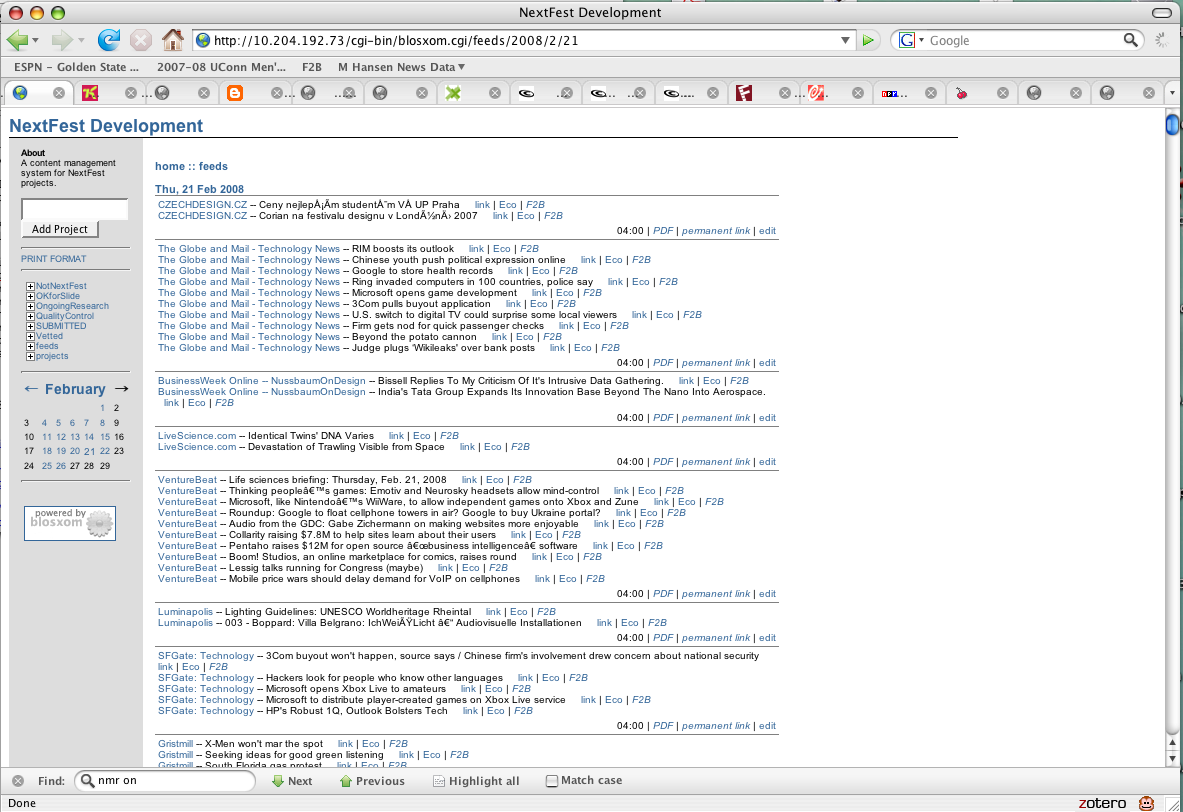
EXAMPLE: http://www.mediagiraffe.org/docs/stenger.png
Stenger says if you
can assemble all the inputs into a
dashboard like his, now the
machine has
got a way to extract insights so that all the data can start life as a
writing
project. Or if the research points
to a
detail that adds to a project underway, the machine should help to plug
those
details in, keep writing projects in order and move the writing into the
news
organization.s larger content management system. Stenger points to Zotero,
an example of a Firefox extension that does something like this. It's a
tool
that is designed for academic researchers to manage their intellectual
workflow. And he wonders if something like this could be useful to
journalists,
too.
Change could go two
directions, concludes Stenger. It could just make the same 900-word
essays
more thoughtful, better written, and possessing greater impact, while
essentially maintaining the same shape and character. Or the increased
productivity might also free up organizational bandwidth to experiment
with new
interfaces, new media formats, or new research methods--call them possible
upgrades to the basic *machine*.
11. John Wilpers and the
embedded
blogs
John Wilpers has spent a career in mainstream media,
editing dailies, writing editorials at The
Boston Globe, and taking professional risks to help start three
different
free dailies in Boston and Washington, D.C. He.s now consulting to the Los
Angeles Times, helping the paper prepare to implement a massive community
blogging strategy. At the free
daily
BostonNOW, which began publishing almost a year ago, some 30% of the daily content is from among
more
than 250 blogs that are on the paper.s website. As BostonNOW.s inaugural editor, Wilpers was adamant about
putting blogger-submitted copy right beside the wires and staff-written
stories. This .reverse
publishing.
strategy is exactly what needs to happen in every newsroom. Wilpers wrote to me: .You have to embrace those community
voices
in your work, in your pages, and on your website. You can.t ghetto-ize
them on
special blogger pages buried in a corner of your website and doomed never
to
appear in print. Embed them in your web pages and in newsprint. Create
opportunities for interaction between them and yourselves as well as
within the
community of readers.. Wilpers says that from his experience at both
BostonNOW
and the LA Times, .I can tell you that when you make a courtesy call to
tell a
blogger his or her stuff is going to appear in the paper, you are creating
a
new fan, potentially a new reader, and certainly a link in a grassroots,
viral
marketing campaign that you couldn.t buy..
However technology and journalism mash up in
the
years ahead, the best-of-breed news organization, in the words of Google
technologist Bob Wyman, .will be
something that includes email, social networking, spreadsheets, accounting
software, etc. . the best newspaper will be an integrated part of a system
that
addresses the users. broad and integrated set of requirements..
Newspapers as Networks:
http://www.naa.org/docs/Digital-Edge/de-social-media07.pdf
RADICAL / CRAZY IDEA NUMBER ONE:
END
THE OMNISCIENT VOICE
So here we go with
four crazy ideas. The first
.
end the omniscient view. Scott
Karp
wrote with the same idea. He said:
.Here.s a radical idea: Instead of writing the editorials with no
byline, the product of some faceless editorial committee, have the editor
who
actually wrote it sign it. The editor should explain how the issue was
discussed and decided with other editors. Make it
transparent..
Consider the
possibility that where you have an editorial
board, deciding positions to take on a public issue . would it make sense
to
report the dissent, or the vote, and might that provide a nuance to the
view
expressed that could actually make it more powerful, particularly when an
editorial is backed by a strong majority or a unanimous editorial
board?
I remember as a
teen-ager coming of age and beginning to
pay attention to newspapers being perplexed at the newspapers, which said,
.The Boston Globe has endorsed . . .
. .
I thought to myself, .How could a
thing endorse a person?. It had to
be a
person or a set of people. Why not say so? The Supreme Court does not
decide a
case, a majority of the Supreme Court does. That majority is composed of
individual justices. Sometimes we
know
the vote and sometimes we don.t. I
think the transparency of the count, and the ratio of support, makes the
decisions of the court more nuanced and more
powerful.
CRAZY IDEA NO. 2 .
THROW AWAY THE EDITORIAL PAGE
Crazy Idea No. 2 goes
a step further to ask this question:
Is it time to throw away the editorial page?
I.m not saying throw away the letters, or the informed commentary .
or
even one or more daily editorials which speak . by name . with the
authority of
a learned editorialist or identified board.
What I.m suggesting is a new name and mission for it. Have this page be the home base for all of the multimedia engagement
efforts of
the 21st century news organization.
And so I would call it the .Engagement. page. Now perhaps we don.t
yet
have the perfect name here . we don.t want people turning THERE for wedding photos . but I hope you get the idea. We can
talk
about the philosophical change a name change would represent.
CRAZY IDEA NO. 3 .
THE CITIZEN JOURNALISM ACADEMY
If our voice is going to include that of referee and coach, then the
21st-century
news organization is going to have to engage with and empower more public
voices. A challenge then, is how to teach those voices to be
effective. In Lawrence, Kansas, the World Company
has
done this by launching a Citizen Journalism Academy. Citizens apply to be a part of the Academy. The World Co. .
which
owns the daily, the cable system and an ISP in the college town west of
Kansas
City . then selects about 25 applicants for a program which involves
once-a-week night meetings for about a month -- to teach them how to
write, how
to shoot video, how to prepare web-friendly copy. The editorialist in charge of the Engagement page might
adopt the
role organizing the local citizen-journalism academy.
Cody Howard, who runs the CJA in Lawrence, says there
are
now over 70 graduates. He says:
.This
is a diverse group of people, highly engaged in the news process.
They provide
content -- print stories and blogs we might not normally be aware of as a
news
organization -- and feedback about stories and projects.. These graduates
don.t
just writing about cooking, music, arts and their personal lives -- they are now infused with a
journalist.s
sense of mission to make a difference. They are covering meetings, events,
ideas . and offering their work to the Journal World and its cable TV and
its
website. It.s a whole new source of serious, original reporting . seeded
by the
local news organization.
Cody Howard works for Ralph Gage, World Co..s general
manager. Here.s what Gage
says: .Efforts such as the Citizen academy
don't
cost much-- pop, cookies, shirts, plaques, etc. They take time and care
and
they build another sort of ROI. But with the landscape changing, it's
imperative to nurture those relationships and to have established yourself
in
the community's mind. Where'd the first reports from the West Virginia
shootings come from?.
CRAZY IDEA NO. 4 . NEWSCAFES.ORG
A
few years ago, I joined the chamber board where I lived at a time when the
president was just opening with his wife their own wireless-enabled
Starbucks-style café mostly to serve the community which swirls around the
2,000-student college in town.
I.ve been
out of the print publishing business for a few years, but I talked to him
about
the idea of setting up a cubby in the back room of his new café, where a
community blogger could meet with sources, officials and fellow observers,
using the café as a physical presence for what would otherwise be a
virtual web
news service.
Then in April of last year, former Berkshire Eagle Editor David Scribner and I starting talking
with a
college in Bennington, Vt., about combining its ownership of the only
radio
station in town . a commercial AM license . with a website and physical
presence in a downtown coffee shop.
The
idea is to broadcast the news, and feed the website, and write the
articles,
from a coffee shop in the center of town.
Two weeks ago, Southern Vermont College announced it was willing to
work
with a community group to make this vision a reality. We.ve registered the domain .NewsCafes.org. to do so.
And so my fourth and
final crazy idea is this: Why don.t
you extend your Engagement page out into the community, forge a
relationship
with one or more coffee shops, and establish your own NewsCafes.org for
meetings, discussions and sharing with your participatory audience?
THE CORE CHALLENGE
To sum up: The core challenge we face is turning
civic
affairs back into a contact sport, not a spectator sport. News organizations must drift away from
detachment, to learn, try and embrace the tools of engagement. To do this requires thinking about
these
voices: Navigator, valet, referee and even coach.
However technology and journalism mash up in
the
years ahead, the best-of-breed news organization, in the words of Google
technologist Bob Wyman, .will be
something that includes email, social networking, spreadsheets, accounting
software, etc. . the best newspaper will be an integrated part of a system
that
addresses the users. broad and integrated set of requirements..
MANNING THE LISTENING POSTS
I.ll give the last
word to our Journalism That Matters
co-collaborator, Chris Peck, the editor and former APME and ASNE
president. He wrote about his
vision of
the .next editorial board nestled inside the next newsroom.. And here.s what he wrote:
.The desks
increasingly will be occupied by young,
Web-savvy personalities . who aren.t there much. No more will the
editorial
board by chained to the telephone. Instead, the editorial board is out and
about at listening posts set up in coffee shops, schools and retirement
centers. Back in the office, the workday for the editorial board involves
hosting online conversations, blogging, tapping into social networks to
gather
feedback and convening community discussions.
And, the opinion writers work directly with citizen contributors.
Together, they help shape the master narratives for empowering, not
discouraging, those who live in a place..
Thank-you.
APPENDIX
A
MORE ON THE POYNTER EXCHANGE:
One thread included an observation from former TV
news
director Terry Heaton. In today.s
world, Heaton said, the masses have access to much of the same knowledge
bases
that the elite experts formerly held and protected. And so the news organization is in a less privileged
position.
.If we are to find our future legs,. writes Heaton. .We must look to view
how
the press can best serve the participatory culture, not one wherein we
function
from elite pedestals..
To this, Steve
Yelvington, the award-winning vice-president of digital
strategy/content at
Morris Digital Works, suggested the reading of Harvard University Prof.
Robert
Putnam.s book, Bowling Alone,
and the
related resources at http://www.bettertogether.org
. Yelvington says Putnam.s
sociology
research shows a strong correlation between .building social capital. and
active consumption of local news.
Does
active news reading bread civic involvement, or the other way around? In
either
case, Yelvington argues, in effect, that news organizations need to come
off
the pedestal and engage. He
writes: .It
may seem heresy to start talking about creating an activist campaign to
build
social capital. But it would not be heresy to a 19th-century
newspaper fonder, many of whom took on community-building as a personal
and
institutional mission..
Taking on a role to .form communities rather than
just
inform them,. is how Poynter senior researcher Roy P. Clark advanced the
comments of Heaton and Yelvington.
Clark says building such social capital may be the best opportunity
for
news organizations to survive and prosper, to help citizens see themselves
as
part of a physical community, and to help strengthen those communities.
In preparing for this evening, I asked Dianne Lynch,
dean
of the Park School of Communication at Ithaca College, for her thoughts on
editorial voice, and her comments, synchronize nicely with the Online-news
thread I.ve just been quoting.
Lynch
says journalists and editorial writers are still experts, but they are
experts
in a sea of independent voices, many of which are equally expert and some
of
which have better information than the journalist. So Lynch says the .new . news professional role is that of
presenter and participant .in the
community as the organizer/convener of conversations in which s/he is not
the
central voice..
That.s in fact, roughly what Bowling Alone.s Putnam apparently recommended two weeks ago at
a
conference organized by the Knight Foundation.
Knight gathered representatives of the nation.s community
foundations to
showcase arguments that those foundations should be putting their
philanthropic
dollars to work supporting local journalism.
In a talk, Putnam called for . . . quote . . . . .practical
strategies
for building a more encompassing sense of .we...
Rich Gordon, who is associate professor and director
of
digital technology in education at the Medill School, heard Putnam.s
speech,
and he blogged: .Putnam.s research
ought to be a clarion call for citizens, journalists and media companies
in cities,
towns and neighborhoods across the United States . . . the new research reinforces the need,
especially in our most diverse communities, to build new ways for people
to
connect with one another..
|
JTM . Journalism as a conversation
For the last 18
months, the Media Giraffe Project has been
working with the Commercial Appeal.s Chris Peck, with consultants Stephen
Silha, Peggy Holman and with Len Witt of Kennesaw State University to
stage a
series of roundtable events on the theme .Journalism That
Matters.. Much of the dialog focuses on what .We The Media. book author
and
Arizona State University professor Dan Gillmor calls . journalism as a
conversation rather than a lecture..
I
asked Holman to summarize JTM.s key strategies. We:
ˇ
Focus on the art of engagement . developing the
skills of
both face-to-face and online conversation, where stories are sourced from
ordinary people and places.
ˇ
Help journalists prepare to be conveners and
navigators.
ˇ
Teach a
.ready,
fire, aim. strategy, moving from idea (ready) to implementation (fire)
without
months of planning (aim). The news industry isn.t used to this
approach. But in an era of open source and
digital
publishing, the cost of experimenting is trivial compared with the cost of
failing to innovate out a spiral to irrelevance.
ˇ
Cultivate renewal of a .healthy inner life. for the
journalist, preparing the next generation, with an eye toward the emerging
citizen journalist role.
ˇ
Our next gathering is http://www.NewsTools2008.org -- April 30-May 3 at
Yahoo-Sunnyvale.