Mainstream Media Meets Citizen
Journalism:
By Rachelle Goh
CMS Senior Thesis
Readers: Julie
Dobrow, Stephen Wilmarth
April 20, 2007
A PDF version of this paper may be viewed
at the
following address, including graphics, links and a table of contents:
http://www.mediagiraffe.org/tufts-thesis/tufts-thesis.pdf
Rachelle Goh (USA Phone: 857-928-6402) is an International Relations
major and
Communications and Media Studies minor at Tufts University, in Medford, Mass. (USA). She has always been interested in
current affairs and in
the interaction between media and society. In 2002, she began blogging, talking mostly about her daily life and her thoughts on what was happening around her, but often self-censoring her writing. Coming from Singapore, where the freedom of the press is limited, she found the concept of citizen journalism intriguing and decided to dig deeper into it through this senior thesis. In her free time, Rachelle likes to cook for her friends, do crossword puzzles, and watch CSI. She is excited to join the conversation on citizen journalism and hopeful for the future of the news media industries.
Problem Statement
In
2002, I hopped on the blogging bandwagon and started my own web log (or blog)
on the pretext that I could
type much faster than I could write, and so it made
more sense to type my thoughts out in order to keep up with myself.
Of course,
I could easily have kept a private diary in a Microsoft Word document, but the
idea that putting my thoughts
on the Internet would make them available to
everyone and anyone intrigued me. While my blog began as a space for me to
vent
my frustrations and “record” the events that took place in my everyday life
– a sort of archive in case I
forgot, I soon realized that through my
blog, I was able to share my views on current events or certain social
issues
with anyone who had Internet access. I was also able to point out issues or
occurrences that I thought deserved
more attention. There was something
captivating about knowing that even a “nobody’s” opinion like mine could be
heard.
As Dan Gillmor writes, “the read/write Web was truly born again. We
could all write, not just read, in ways never
before possible. For the first
time in history, at least in the developed world, anyone with a computer and
Internet
connection could own a press. Just about anyone could make the news.”[1]
And just about anyone has. With the rise of citizen journalism, an
increasing
number of people are “getting their understanding of the world from random
lunatics riffing in their
underwear, rather than professional journalists with
standards and passports.”[2]
This
Communications and Media Studies senior project aims to explore the issue of
citizen journalism: what does
citizen journalism mean for the newspaper
industry? Of all the different forms of mainstream media, the newspaper
enjoys
the longest history. Despite the invention of the radio and the television, and
their advantage of being more
vivid and attractive in their telling of the same
news, the newspaper managed to survive in those days by adapting and
keeping up
with the times. More recently, newspapers have also had to deal with the
“explosion” of the Internet over
the past few years. Although most newspaper
companies have responded by putting their content online for users to
access for
free, some newspapers, such as the New York Times, have now put select content
behind a subscription wall
– one has to pay to access such content. This
move by the New York Times has been lauded by some, and heavily
criticized by
others. Exactly how newspapers should harness the power of the Internet is one
of the questions that this
Communications and Media Studies senior project will
attempt to answer.
Another
issue facing newspapers today is that of
citizen journalism. The rise of
citizen journalism, whether it be the “informal” blogs offering someone’s take
on the
news, or more “formal,” organized platforms such as www.ohmynews.com,
www.globalvoicesonline.org, and
www.backfence.com, is changing the way in which
society receives and transmits information. The Pew Research Center for
the
People and the Press claims that “11 percent of Internet users – 14
million Americans – read blogs,”
and that growth has been astounding
– “in 2003, 2.5 million people blogged and in 2004, as many as 8.8
million
people blogged.”[3]
According to measurement tool technorati.com, 15,000 new weblogs are
created
every day and new conversations are initiated every 3 seconds.[4]
Today, “citizens consume the content that citizens create.”[5]
But is citizen journalism affecting the way news is reported and
received as
much as it has been hyped to?
This
is a huge area of concern that is especially worrying for journalists and
the
newspaper industry, as it foretells a time when newspapers may not even be
necessary anymore. It is obvious that
people in the business of journalism are
concerned: the theme of MIT’s Communications Forum this year was
“Will
Newspapers Survive?” and Harvard’s Shorenstein Center for Press, Politics and
Public Policy celebrated its
20th anniversary with a series of panel
discussions on topics including “Traditional News Media: Optimism,
Pessimism
and Realism” and “New Media and News: Peering Over the Horizon.” At the same
time, the growth of citizen
journalism also raises issues for citizens
themselves. The use of the word “citizen” to describe their form of
journalism
carries with it connotations of participation in a democratic society. Does
citizen journalism really have
democratic potential and what does that mean for
society? This Communications and Media Studies senior project will
look into
all of these issues surrounding citizen journalism.
Project Significance
Firstly,
this project has great social and academic significance as it deals with a
current phenomenon that is
pertinent to our abilities to be well-informed
citizens of a democratic society. Recent events such as the London
train
bombings in 2005 show how citizen journalism played an active role in shaping
media coverage in the immediate
aftermath. A smoky image of people being
evacuated along a train tunnel minutes after the bombing was taken by
Adam
Stacey on his camera phone, and posted online on Alfie Dennen’s mobile blog
within an hour of its occurrence.[6]
Over the next few hours, news organizations such as the BBC, CNN and
the New
York Times jumped on
this picture and used it in
their breaking news reports. This camera phone
picture, taken by an ordinary Londoner at a place and time that was
not
accessible to the cameramen of mainstream media, has come to define the London
train bombings, and demonstrates how
the relationship between mass media and
society is changing. The debate on the use and significance of
citizen
journalism is very vibrant right now, and I hope to join the conversation.
Secondly,
this project also has political significance. Citizen journalism has become
involved in the United
States’ political scene, one recent example being the
video of Senator George Allen using the racial slur “macaca”
during a campaign
stop spreading like wildfire through YouTube.com, stirring up enough controversy
that finally cost
Senator Allen his 2006 bid for re-election.[7]
As the 2008 elections approach, many candidates have recognized the
power of
citizen journalism and are beginning to harness it through posting videos
online and recruiting political
bloggers as part of their campaign. It will be
exciting to see how much citizen journalism will affect the upcoming
elections.
Third,
this project is personally significant. As I am personally involved in using
the Internet to get my voice
heard, and have a deep-seated interest in the
numerous issues surrounding this powerful tool, this project will help me
see
how my actions and interests fit into the bigger picture.
This
project also took on another level of significance in light of the shooting
that occurred at Virginia Tech
on Monday, April 16th, 2007. In the
hours that followed, it was the blogs of Virginia Tech students that
provided
eyewitness accounts of what had happened and a live count of the death toll.
Unable to provide this news
faster than the students themselves, the mainstream
media turned to these blogs as their sources of information, often
lagging
behind the blogs in the death toll (ABC News was still reporting a death toll
of 20 students when it had
already reached 33 on blogs – which later
turned out to be the correct number). A video of police running with
their
weapons drawn and gunshots being fired in the background, captured by a student
with his cell phone camera,
became the backdrop of all the mainstream media’s
reporting. This incident, one of the first major ones since the birth
of social
networking sites like Facebook and MySpace, resulted in a furor of activity
that may also have had a harmful
effect on the public sphere by providing
un-vetted misinformation. While I am deeply moved by this incident and
continue
to pray for the students at Virginia Tech, I also recognize the significance
that it has for the role of
citizen journalism in the media industries.
Literature Review
In
order to better understand the discussion of citizen journalism, I will first
provide background information
in certain key areas: the role of journalism,
the rise of the Internet and the Internet as a form of mass media, a
working
definition of citizen journalism, examples of different forms of citizen journalism,
and the current
conversations on issues surrounding citizen journalism.
The Role of Journalism
The
press, or journalism, is often referred to as the fourth estate – a
necessary component that acts as
the watchdog for a healthy democracy. This is
a huge responsibility, indicative of the important and integral role
that
journalism plays in our society. According to Michael Schudson, journalism is
“the business of a set of
institutions that publicizes periodically (usually
daily) information and commentary on contemporary affairs, normally
presented
as true and sincere, to a dispersed and anonymous audience so as to publicly
include the audience in a
discourse taken to be publicly important.”[8]
In this definition, we see that journalism is both a “business” and
at the same
time a practice that should serve the public interest – goals that seem
to be mutually exclusive. Two
models that are used to understand the media
business – the market model and the public interest model –
provide
different frameworks within which to analyze and understand this tension
between business interests and the
public interest that exists in journalism.
Market Model vs. Public Interest Model
The
Market Model is similar to the perfect competition or free market model that one
would encounter in
economics. It suggests that “society’s needs can best be met
through a relatively unregulated process of exchange based
on the dynamics of
supply and demand.”[9] In other
words, profit-seeking businesses will always be able to
provide for the demands
of consumers as long as there is free competition amongst producers. Hence, the
media should
not be regulated by the government. Instead, by being
profit-seeking, it will best be able to meet the public’s needs.
While this
economics-focused model argues that having a free market promotes efficiency,
responsiveness, flexibility
and innovation within the media industry, it can
also give rise to monopolies or homogenized competition, which are a
disservice
to the public.[10]
Applying
this framework to journalism provides an explanation for some recent trends.
For example, news
producers have both been responsive and flexible to the
demands of their consumers, giving them more of what they want
and less of what
they do not want, and adapting to these demands quickly. However, these
advantages of free markets
have resulted in a sharp rise in the production of
infotainment – a watered-down version of news programs,
including more
entertainment features than serious content. The need to remain competitive and
increase viewership in
the short run has led many news broadcasters to produce
more infotainment and less “hard news.” Such news programs are
unlikely to
provide enough “information and commentary on contemporary affairs”[11]
to produce an informed
citizenry.
Furthermore,
in order to stay ahead of the competition, news producers have found it
necessary to constantly
provide news, whether it be on cable television with
news around the clock, or through morning and evening editions of
the same
newspaper with “new” news later in the day. Due to the flexibility, efficiency
and innovation of news
producers in a free market, they have responded to
consumer demands by providing a neverending stream of news. Although
it may
appear to be a good development at first, the pressure on journalists to
constantly produce new stories has
resulted in a sub-par standard of reporting,
with sources that are not thoroughly checked because of the time pressure
to be
the first to break the news.
More
worrisome is the fact that mergers and acquisitions have taken place in the
media industry resulting in the
convergence of a few big media conglomerates
controlling numerous sources of information. Unbeknownst to most of
the
population, when they switch from CBS to UPN, or from MTV to Nickelodeon, they
are still watching content owned by
Viacom. Even when they watch Paramount
films and read books published by Simon & Schuster, they are
still receiving content controlled by
Viacom.[12]
Six media
conglomerates – Viacom, Time Warner, General Electric, Vivendi,
News Corp, and Disney – control ninety
percent of what we see, hear, and
read.[13]
That is scary to say the least. What happens to democracy when only
a few
powerful voices can be heard? In the strong words of Ronnie Dugger, “these few
corporate monarchs set the
pervading tones and agendas for us all. …Freedom of
the press has been upside-downed into corporate control of the
press… Freedom
of the press, far from guaranteeing democracy – its purpose when the
country was founded –
now protects the corporations that are methodically
debasing democracy.”[14]
Unlike
the Market Model, the Public Sphere Model,
on the other hand, suggests that the
free market does not satisfy all of society’s needs.[15]
Moreover, there are
some societal needs that “simply cannot be met via the
market’s supply and demand dynamic.”[16]
These needs, such as diversity and substance, are in the public
interest, but
because they have little economic value, are disregarded in a market system
based on consumer purchasing
power. Finally, the Public Sphere Model argues
that “because it is vital to a robust democracy, media content cannot
be
treated as merely another product… profitability cannot be the sole indicator
of a healthy media industry.”[17]
As such, this model acknowledges the role that the government can
play in the
media industry to ensure that public interests are met.
According
to Croteau and Hoynes, analyzing the
media through the public sphere framework
reveals some shortcomings of the free market system. Firstly, the free
market
is not democratic – the company with the most money is entitled to more
power and influence in the
marketplace. Secondly, as a result of the
undemocratic nature of the free market, inequality is perpetuated. The
income
inequality present in society is reflected in the media: as explained above, we
tend only to hear the voices and
opinions of the rich and powerful mediaconglomerates, while independent sources struggle to be heard. Third, the
free
market system does not have moral values, as everything is based on
profitability. Lastly, the free market is
unable to meet social or democratic
needs.[18]
For example, the public media is “an invaluable resource that
should be
available to citizens regardless of their ability to pay,”[19]
but the forces of supply and demand do not allow for the provision
of such
public goods. Also, news created toward “grabbing and holding the attention of
consumers by shocking or
pandering to them”[20]
does not serve to inform the public and allow them to participate
in meaningful
democratic discussion.
Evidently,
the basic difference between the Market Model and the Public Sphere
Model is
the way in which they view people: the Market Model sees people as consumers
whereas the Public Sphere Model
sees people as citizens.[21]
While the Market Model depicts the reality of journalism these
days, the Public
Sphere Model illustrates an ideal of what journalism should look like: a system
that is accessible to
everyone, where there is a free flow of information, and
where there is breadth and diversity in the ownership and
control of media
outlets.[22] The
development and rise of the Internet as a new form of mass
media has brought
journalism one step closer to this ideal.
The Rise of the Internet
Most
of
us today cannot remember the world without email, instant messaging and
Google. Parents’ stories of growing up without
computers sound sacrilegious to
today’s Information Age individuals working in a knowledge-based economy.
Although the
Internet is relatively young, it has revolutionized mass communications
in such a way that people now think of time as
pre-Internet and post-Internet.
In fact, the Internet started out as a military system and only became
available to the
public in 1995.[23]
However, in the short span of ten years, the growth of the Internet
has been
staggering. In December 1995, the Internet had 16 million users, or 0.4% of the
world population. Just five
years later, the number of users had skyrocketed to
361 million, more than 22 times the original number.[24]
The latest statistics
in December 2006 indicate that there are now 1.1 billion
Internet users, making up 16.6% of the world population.[25]
This rate of growth is
unprecedented. According to some media analysts, “it
took electricity 50 years to reach 50 million users in the United
States,
whereas it took radio 38 years, it took personal computers 16 years, it took
television 13 years, and it took
the Internet just 4 years.”[26]
Indeed, John Pavlik did not exaggerate when he hailed the Internet
as “the
first and perhaps most powerful medium of global interactive communications.”[27]
Not
only is the Internet revolutionary because of its global reach, it is also the
one medium that has been able
to integrate all other forms of communication.
While the television combined only audio and video, the Internet
embraces “all
the capabilities of the older media (text, images, graphics, animation, audio,
video, real-time
delivery).”[28]
What is more, the Internet also enables “interactivity, on-demand
access, user
control, and customization.”[29]The Internet has undeniably become a form of mass media. But that is
not all.
The Internet is still constantly growing and evolving as users explore its
different facets and discover new
ways of harnessing its communicative power.
The Rise of Blogging
One
of
these new forms of communication is the web log, better known as the “blog.”
A blog is an online journal of sorts, a
personal space on the Internet that a
blogger (someone who writes a blog) can fill with whatever content
he/she
pleases. Some Internet users have used their blogs to talk about their everyday
lives, to provide insight into
their line of work (work blogs), to talk about
new gadgets and technological developments (tech blogs), to comment on
politics
– the list is virtually endless. According to one journalist, these blogs
are “proliferating like stars
in the sky.”[30]
74.9 million stars, to be more exact – a result of the
blogosphere (total
blogs tracked) doubling every 5-7 months from 2004 to 2006.[31]
Although the recent
doubling rate of blogs (tracked by Technorati) has slowed
to 320 days – and this is slow only in comparison to
its initial growth
rate – it is more because of Technorati’s improved ability to filter out
splogs (spam blogs).
Technorati’s April 2007 “The State of the Live Web” report
boldly claims that “the state of the Blogosphere is strong,
and is maturing as
an influential and important part of the web.”[32]
While
a
good number of these blogs are personal rants, have low readership, or could
even be dead, there are a number in each
industry/field that have risen to the
level of national prominence. For example, in the area of politics, blogs
like
Daily Kos (http://www.dailykos.com), a
liberal blog, receive about 600,000
daily visits.[33]
Engadget (http://www.engadget.com), a
tech blog, ranked number 19 in Technorati’s “Top 50
Blogs and Mainstream Media”
ranking, with more than 20,000 inbound blog sources.[34]
Indeed, the blogging
phenomenon has changed the information landscape. “They
[blogs] were the first tool that made it easy – or at
least easier
– to publish on the Web.”[35]
Anyone with a computer now owns a press.[36]
No longer are individuals merely consumers, they are now also
producers of
information. This paradigm shift from consumer to consumer
and producer has sparked an entire movement
of user-generated
content now known as Web 2.0.
Web 2.0
The
combined December 25, 2006 and January 1, 2007 issue of TIME was titled “Person of the Year: You.” On
the cover was a graphic of a computer showing a YouTube video
being played.
Reflective Mylar was used to create a mirror for the screen portion of the
graphic because it “literally
reflects the idea that you, not we, are
transforming the information age.”[37]
This development from the Internet as simply another means through
which
producers could reach consumers to the Internet as a tool for consumer
empowerment has been dubbed “Web 2.0.” In
the age of Web 2.0, it is “not enough
just to find that obscure old movie; now you can make your own film,
distribute
it worldwide and find out what people think almost instantly.”[38]
Not surprisingly, a
plethora of websites has sprung up to jump on the Web 2.0
bandwagon.
Some
noteworthy websites that promote the Web 2.0 mindset include:
- Amazon.com – its use of
customer reviews, lists and guides
(providing “if you liked this…”-style
recommendations) has made shopping a communal experience;
- Wikipedia – a
crowdsourcing model that shows that “the masses are as smart as the
experts;”[39]
- YouTube – the video
hosting
and sharing site that allows everyone to be director, producer and
actor;
- Digg – a
website that
allows the crowd to become news editors by “digg”-ing stories that they
like and “burying” those that they
do not like;
- Last.fm – the
self-proclaimed “social music revolution” that “learns
what you like” in
order to make personalized recommendations and connect users with similar
tastes.[40]
This list is
certainly not exhaustive, with many more websites emerging to join
their ranks
every day.
Whether
all this user-generated content can be considered citizen journalism is
questionable as it depends on
one’s definition of citizen journalism, which is
by no means set in stone at this point. What is clear though, is that
“from
YouTube auteurs to bloggers to amateur photographers competing with the
paparazzi, user-generated content is
revolutionizing the media landscape” and
is something that everyone, especially those in the media industries, needs
to
be aware of.
Working Definition of Citizen Journalism
Citizen
journalism is one of many buzzwords that were born as a result of the
development and rise of the
Internet. Broadly speaking, it refers to a break
down in the traditional relationship between the “monologue
broadcaster” and
the “grateful viewer.”[41]
Because of the globalization and empowerment that the Internet
causes,
“journalists now need to think about a global audience that not only reads what
they write and report but can
comment, provide perspective, and offer newinsight into the complexities of an increasingly global
society.”[42]
Much like how the clothing brand FUBU acquired the meaning “For Us,
By Us”
(referring to African Americans) in its attempt to make a statement against
predominantly white-owned sportswear
companies exploiting African American
culture for their clothing designs, citizen journalism has come to mean a type
of
journalism that is “of the people, by the people, as well as for the
people;”[43] a type of
journalism
that has its roots in a dissatisfaction with the quality of news coming
from the media
conglomerates.
However,
many in the media industries agree that citizen journalism is somewhat of a
misnomer. Journalism,
according to Phil Primack, is a process “that centers on fact-based, balanced, edited and
verified
information, presented in a coherent and understandable way, to as broad an
audience as possible.”[44]
It is a “science that requires some training and
qualifications, certain
ethical standards, and credibility.”[45]
Therefore, so defined, it is not possible for any random citizen to
be a
journalist, but it is, however, possible for any random citizen to practice
journalism, provided that facts are
checked, information is verified, and the
information is broadcast – a given with the
Internet.
Looking
at the bigger picture, Bill Densmore claims that “the phrase “citizen
journalism” is an imperfect attempt to describe a
new class of observer and participant in the public
sphere.”[46]
According to Densmore, before the Industrial Revolution things
moved at a
slower pace and citizens were able to engage in civic affairs locally and
personally, thus there was little
need for a journalist. But as the world
population grew, globalization occurred, and business and communication
took
place at a faster pace, citizens were less able to personally experience
everything that was going on around them;
“and so the civic sphere began to
depend upon proxies of the public to gather critical news –
journalists.”[47]
However, over time, commercial interests have taken over these
journalistic
services, influencing the type of news that is reported and preventing
“information necessary for the
functioning of a democracy”[48]
to be broadcast. Citizen journalism is therefore the new
development of
citizens taking advantage of the low cost of entry, through the Internet, to
once again observe and
participate in the public sphere. It is a “form of
social production”[49]
that is redefining the concept of community on the
Internet.[50]
As such, the concept of citizen journalism is constantly changing
and evolving
every day.
In
the seminal report “We Media: How Audiences are Shaping the Future of News and
Information,” citizen
journalism is described as “a citizen or citizens playing
an active role in the process of collecting, reporting,
analyzing anddisseminating news and information.”[51]
This is the working definition of citizen journalism that will be
used for the
purposes of this thesis. To further elaborate on this definition,
citizen
journalism:
…can encompass blogs that represent
commentary on the day’s
events or blogs that serve as community news postings.
It can involve a wiki, in which a news item or commentary is
posted and anyone
can add to or edit it. It can be a podcast reviewing favorite groups on a local
music scene. It can
be a collaborative effort between a reporter and experts to
write and report a story, or it can entail a niche group of
people, such as
office workers or homeless activists, who publish news, information, and
insights about their world.[52]
While it may
seem as if citizen journalism is creeping into every aspect of
mainstream media
to overthrow existing practices, it is important to realize that citizen
journalism is not necessarily
an attempt to take over the traditional news
media, but to complement and supplement it.[53]
In fact, both forms of journalism will not be able to survive
independently.
This discussion will be pursued later in the thesis.
Types and Examples of Citizen Journalism
To
ensure a more complete understanding of the different forms that citizen
journalism can take, this section of
the literature review will showcase a few
examples. The following examples are by no means better than others, but
were
selected more to clearly illustrate the different types of citizen journalism.
The types of citizen journalism
highlighted here are also not exhaustive. As
this field is changing every day, not only is an exhaustive list
virtually
impossible to compile, it will also be out-of-date within minutes.
Hyperlocal News
–
Backfence.com
 Figure 1: Screen shot of
Backfence.com (17 April, 2007)
Figure 1: Screen shot of
Backfence.com (17 April, 2007)
Backfence.com,
started by Mark Potts and Susan DeFife, revolves around the idea
of, literally,
a back fence – but in virtual reality. Before the age of computers, the
back fence was the place
where conversations between neighbors frequently took
place, where information about the local community was exchanged.
Now, people
rarely have the time to stand at their back fences and talk to their neighbors.
They may work long hours,
have to shuttle the children around, or may simply want
to multi-task. Not only does Backfence.com allow people to do
all that they
need to do while still keeping in touch with the goings-on in their
neighborhood, it expands the
conversation from one between next-door neighbors,
to one between everyone in the entire community. Answers to
questions such as “What's happening with the new development down the street?
Does anybody
know a good house painter? What's the best place in town to find
good Thai food? Who's going to be the new junior high
school principal? Anybody
got tips about good bike trails? When is the next PTA
meeting?”[54]
can all be found at Backfence.com, where all content is
citizen-generated. In
their words: “none of us knows as much as all of us.”[55]
Accordingto co-founder Susan DeFife, Backfence.com was started “to fill a gap left by
metropolitan daily
newspapers that were stretching to cover the ever-expanding
metropolitan area.”[56]
What is exciting about Backfence.com is that although it began by
catering to
one neighborhood in the suburbs of Washington, D.C., its model of providing
hyperlocal news has caught on
and Backfence.com now operates in 13 different
neighborhoods, including some in California and Illinois. The founders
have
also been able to make this venture economically viable by hosting local
advertisements and online business
listings, and have even recently received
funding from investors.
International News
–
Globalvoicesonline.org
 Figure 2: Screenshot of
Global Voices Online (17 April, 2007)
Figure 2: Screenshot of
Global Voices Online (17 April, 2007)
Global Voices Online is a non-profit citizen journalism projectthat was initiated by Harvard Law
School’s Berkman Center for Internet and
Society. The website aims to “aggregate, curate, and
amplify”[57]
global conversations, drawing special attention to areas and people
that are
usually overlooked by the mainstream media. In order to ensure the credibility
and legitimacy of the bloggers
and the stories that they contribute to the
website, Global Voices Online has an international team of volunteer
authors,
regional blogger-editors and translators that have either been invited to
contribute or hired (editors).
Because these people are natives of their
country, they are able to understand the context and relevance of
the
overwhelming amount of information that comes out of their country every day,
to sieve through this information,
make sense of it, and highlight what
mainstream media is leaving out and bloggers are picking
up.[58]
The
team at Global Voices Online recognizes that “the international
English-language media ignores many things
that are important to large numbers
of the world’s citizens, …[and] aims to redress some of the inequities in
media
attention by leveraging the power of citizens’ media.”[59]
Part of their work towards this goal includes an Outreach program
that helps
people in oppressed areas to find their voice online, and the daily translation
of their news content into
seven different languages – perhaps more in
the future.
Online Newspaper
–
Ohmynews.com
 Figure 3: Screenshot of OhmyNews
(17 April, 2007)
Figure 3: Screenshot of OhmyNews
(17 April, 2007)
Seven
years ago, before citizen journalism was a
buzzword, Oh Yeon-ho of South Korea
started OhmyNews, an experiment that he hoped would encourage “every citizen to
be
a reporter.”[60] Seven years
later, OhmyNews has become a poster child for citizen
journalism. The original
Korean version of OhmyNews began with 727 citizen reporters and 4
editors,[61]and now boasts 41,000 citizen reporters.[62]
All articles are read by staff editors before being published
online –
“about 70 percent of the roughly 200 stories submitted each day”[63]
make the cut. In fact,
according to Oh, “while citizens like to write their own
articles, many also like to be edited by professional
journalists.”[64]
With this in mind, Oh’s model has merged the benefits of citizen
journalism,
such as its diversity of voices, with the benefits of traditional journalism
– its editing and
vetting capacity. Furthermore, OhmyNews has an
interesting economic aspect: contributors of top stories that make it to
the
front page are paid ten to twenty dollars, and “site users can pay a “tip” to a
particular story’s citizen reporter
if they like the story.”[65]
This could very well become a business model for citizen journalism
in the
future.
In
2003, this OhmyNews model of journalism was replicated in Denmark by Eric
Larsen, creator of Flix.dk.[66]
Soon after, in 2004, an English version of OhmyNews –
OhmyNews
International – was launched. This expansion in outreach was followed by
an expansion in content to
include podcasts and video with citizen anchors.
Most recently, OhmyNews Japan debuted in 2006 with 1,000 citizen
reporters.[67]Oh may not have realized this back in 2000, but what he has started
could very
well be the basis for a new model of journalism. “The traditional paper says ‘I
produce, you read’,” claims
Oh, “but we say ‘we produce and we read and we
change the world together.’”[68]
Collaborative News
–
Wikinews.org
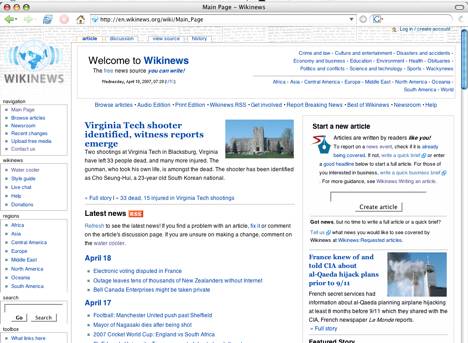 Figure 4: Screenshot of
Wikinews (17 April, 2007)
Figure 4: Screenshot of
Wikinews (17 April, 2007)
Employing
the same software
technology of its better-known counterpart Wikipedia,
Wikinews uses a wiki to enable anyone to revise or contribute
content.[69]
As such, news stories can be built from a single sentence
describing an event
or observation, with contributors adding, removing, and/or improving on the
content. It is
everyone’s collaborative effort that creates the news stories on
Wikinews. This form of “journalism” facilitated the
reporting of incidents such
as the London train bombing in 2005 and the Indian Ocean tsunami in 2004. In
both cases,
“the beginnings of Wikinews articles appeared on the site within
minutes of the events. Initial information was just a
few sentences, but
revisions were made every few minutes,”[70]
and in this manner, a news story was developed. The beauty of wiki
technology
is that even today, years after those two events, the articles can still be
revised to further improve their
accuracy or updated to reflect new
information.
While
it is inevitable that “John Seigenthalers”[71]
will occur now and then, Wikinews has gone to great lengths to
ensure that the
news published on its websites is as close to journalistic standards as
possible. A Wikinews guide to
writing an article begins by asking the question
“Is your story news?,” directing users to the Wikinews content guide
where
specific instructions are given: articles must be written from a neutral point
of view, sources must be cited,
and reporting must be original.[72]
And if any of these standards are not met, we will have to trust
the 10,299
registered users (as of October 2006)[73]
to discover and revise.
Vlog –
Jetsetshow.com
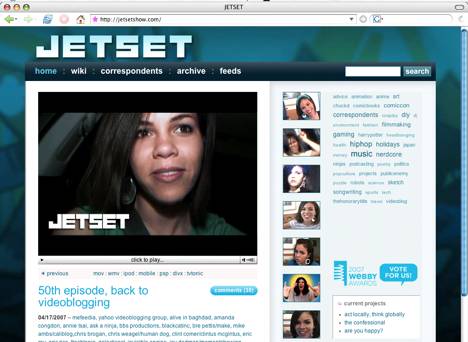 Figure 5: Screenshot of
Jetset (18 April, 2007)
Figure 5: Screenshot of
Jetset (18 April, 2007)
In
the
beginning, there were blogs where people could scribble their thoughts
online. Most were text-only. Then, as it became
easier to upload and store
photos on the Internet for free, people began inserting images in between their
text and
setting up photologs, or the pictorial version of a blog. Now, with
YouTube – a free distribution channel
allowing anyone and everyone to be
producer, director and actor, we have the vlog (video blog). Jetset, one of
many
vlogs currently in cyberspace, is a Vloggie Award winner. Created by Zadi
Diaz and Steve Woolf, it is a five-minute
weekly installment about global teen
culture, featuring correspondents in both the United States and
Japan.[74]
Unlike other vlogs
that feature people talking about their own lives, Jetset
provides an informal and upbeat kind of “soft
news.”
Combining
the concepts of vlogs and podcasting, Justin Kan has coined the term “lifecasting”
to describe his
project, Justin.tv. Kan has a camera attached to his head 24/7
– in the bathroom, on a date, in the car,
everywhere he goes – that
delivers a live feed to Justin.tv. The only time the camera is taken off his
head is
when he goes to bed. Essentially, what this means is that by going to
his website, we can see and experience the life
of Justin Kan for ourselves.
Although Justin.tv has only been broadcasting live for 30 days (as of April 18,
2007), it
has already gained hundreds of loyal viewers. Using a business model
based on product placement, “Kan’s ultimate goal
is to build the site into a
network of hundreds of lifecasters, each with their own channel, making it yet
another
competitor to traditional television.”[75]
While it is unclear if Kan’s “lifecasting” is citizen journalism
per se, it
will be interesting to see how it develops and if citizen journalists will
adopt the
concept.
Pro-Am Collaboration
–
Assignmentzero.net
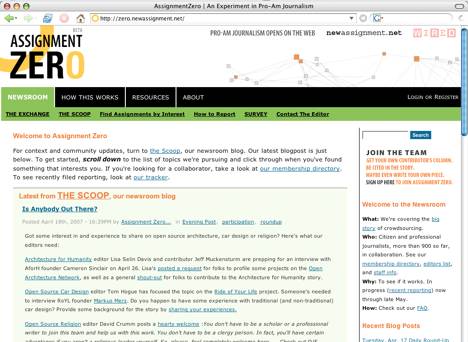 Figure 6: Screenshot of
AssignmentZero (18 April, 2007)
Figure 6: Screenshot of
AssignmentZero (18 April, 2007)
Initiated
by New York University’s
Jay Rosen in March 2007, AssignmentZero is an
experiment in pro-am journalism. “Pro” refers to professional journalists
who
will guide, edit, set standards, oversee fact-checking and ultimately publish
the final version of the story. “Am”
refers to members of the public –
citizen journalists – who will voluntarily contribute to the project
on
their own time if they feel so inclined.[76]
Pro-am journalism, inspired by Korea’s OhmyNews, is the
collaborative effort of
both professionals and citizen journalists to produce news stories. While this
project is still
in the experimental stage and its outcome is hard to predict,
the hopes of a future model for journalism rest on its
success. In the words of
Rosen, “AssignmentZero is a starting point, a base line. Who knows where we
will end up. But
if reporting in the open style ever comes into its own –
at our site or someone else’s – that might very
well change journalism
and expand what’s humanly possible with the instrument of a free
press.”[77]
Many
other examples of citizen
journalism exist on the Internet, with that number
increasing every day. The “case study” examples presented here
illustrate the
changing relationship between information and society. While in the past
society lapped up whatever
information the mainstream media presented to it,
now society is playing an active role in aggregating, organizing, and
even
creating information. However, there are two sides to every coin. Citizen
journalism has a lot of potential, but
it is not perfect.
Method
Interviews
Considering
the fact that citizen journalism directly affects the livelihood of journalists
and those working in
the various media industries, it was only logical that I
should interview industry professionals to get a sense of the
sentiments of
those in the field. My list of people to interview started out with contacts
provided by both of my
thesis readers, as they knew suitable people through
their line of work. Some of these contacts then in turn introduced
me to other
people that they knew who I could interview. This social network proved
extremely useful and provided me
with six interview candidates, including
people in the media industries, professors of media and journalism, and
bloggers.
As most of these people are busy professionals, the interviews were conducted
through email. After receiving
their initial responses, I replied with
follow-up questions to clarify certain issues or ask more about
interesting
ideas, thus creating the effect of having a conversation.
This
semester, on top of my classes, I also did an internship at Cone, Inc., a
marketing and public relations
firm that is part of the Omnicom Group. My
mentor at Cone, Inc. introduced me to their New Media Director, Brian
Reich,
who kindly agreed to be interviewed for my thesis. I also interviewed Glenda
Manzi, who is teaching a course at
Tufts, offered for the first time this
semester, called “Television in the Age of YouTube.”
Interview
Candidates
Bill Densmore is the director and editor of the Media
Giraffe Project at the University of Massachusetts-Amherst and the
New England
News Forum. He is also a director of the Action Coalition for Media Education.
As a career journalist, he
has written for The Associated Press, the Boston
Globe, ComputerWorld
Magazine, and various trade publications. He also
spent some
time working in public radio.
Aldon Hynes is a
blogger at http://www.orient-lodge.com. Before
entering the blogosphere, he
worked as an IT Executive on Wall Street. Now, he
spends his time blogging, some of it professionally. He also speaks
at
conferences about blogging and works for campaigns that he believes in, such as
Governor Dean’s 2003 presidential
bid. In 2004, Hynes received credentials from
the Democratic Party to cover the National Convention as a
blogger.
Jill Lang currently teaches the course
“Citizen
Journalism and the Web” for University of Massachusetts-Amherst’s Certificate
of Online Journalism. She has
more than 20 years of experience in community
journalism, which includes writing for the Gloucester (Mass.) Daily
Times, the Portland (Maine) Press
Herald, the Maine Sunday
Telegram, and the Rockland
(Maine)
Courier-Gazette. Lang
also spent the last seven years
building a community journalism model –
VillageSoup (http://www.villagesoup.com)
– that merges a community online with a local
weekly newspaper.
Colin Maclay is the Managing Director of the
Berkman
Center for Internet and Society at Harvard Law School. He is also a fellow at
the University of Washington’s
Center for Internet Studies and Advisor to the
World Computer Exchange. Especially interested in information and
communication
technologies (ICTs), he has worked in India, Latin America and at the
international level on ICT policy,
and aims to effectively integrate ICT with
social and economic development.
Glenda Manzi teaches the course “Television in the
Age of YouTube” at Tufts University. Before teaching at Tufts, she
worked as
Executive Producer for Botticelli Interactive, an Internet new media company.
Her career also includes more
than 25 years of experience in television, radio,
newspapers, and Internet media. The majority of her career was spent
working at
WGBH-TV, Boston’s PBS affiliate, producing news and documentaries. Manzi is a
three-time Emmy Award
winner.
Phil Primack is a freelance writer and editor
based
in Medford, Massachusetts. His work covers politics, the economy and other
public policy issues, and has appeared
in the New York Times, the Boston
Globe, CommonWealth, Boston, and the Columbia Journalism
Review. He has been a policy advisor to elected
officials such
as former congressman Joseph P. Kennedy, II. Primack also
teaches the course “Media Law and Ethics” at Tufts
University.
Brian Reich currently works at Cone, Inc. as the
New
Media Director. Before working at Cone, Reich was involved in politics, serving
as Vice President Gore’s Briefing
Director in the White House, and consulting,
running his own business. A self-professed new media-junkie, Reich writes
and
speaks regularly on issues involving the impact of the Internet and technology
on politics, society and the media.
He is the editor of Thinking About Media
(http://www.thinkingaboutmedia.com)
and contributing editor to the
Personal Democracy Forum
(http://www.personaldemocracy.com).
Stephen
Wilmarth is the
co-founder and Director of
Program Development at the Center for 21st
Century Skills, where he works on designing and delivering
programs that foster
essential academic, analytic, communicative and creative skills for high
schools in Connecticut.
He has taught in public and independent schools forfive years. Wilmarth is also a technology entrepreneur, and has led
seminars on
e-business and strategy at various universities such as MIT’s Sloan School of
Management and London
Business School.
Interview
Questions
The
following were my initial interview questions:
- What do you consider citizen
journalism to be?
- What do you think about
the rise of
citizen journalism? Why/Please elaborate.
- How has your company/what you do
integrated citizen journalism into its products/services? If it hasn’t,
why not?
- What do
you see as some of the
possible advantages of the citizen journalism movement?
- Do you
think citizen journalism is a
threat to the media industry? Why or why not?
- What effect has citizen
journalism
had on your daily work?
- Do you think the media industries
should embrace
citizen journalism? Why or why not?
- What has citizen journalism meant
for newspapers?
Television? News that appears on the Internet?
- What do you think about the claim
that citizen
journalism has democratic potential?
- What impact do you think citizen
journalism will
have on society at large?
- Because citizen journalism does not
necessarily go through the same
vetting process that mainstream journalism
goes through, what do you think the public at large needs to understand
about citizen journalism?
Depending on the
responses I received, the interviews went in different directions. Some
follow-up questions
that I asked were:
- What are some problems
that you see
with citizen journalism?
- What do you think about the argument
that the
rise of citizen journalism has caused a fragmentation of society,
with people only reading the news that interests
them? Doesn’t this work
against citizen journalism’s claim of enhancing democracy?
- What do
you think about the argument
that the blogosphere is self-correcting, that the power of the crowd is
able to prevent
misinformation from perpetuating?
I analyzed the
results of these eight interviews alongside the literature that I found on the
promises and
problems of citizen journalism, its democratic potential, and the
issue of vetting and
fact-checking.
Conferences
I
had
the privilege of attending two conferences, which drew my attention to
issues that media professionals themselves
thought to be important and also
shaped my conception of citizen journalism. The first was the MIT
Communications Forum
2006, with the topic “Will Newspapers Survive?” I attended
the session on “The Emergence of Citizens’ Media,” where I
was introduced to
the ideas of Dan Gillmor, the author of We The Media: Grassroots Journalism
by the People, for the
People,
a great book that truly embraced the concept of citizen
journalism by posting
drafts of chapters online for anyone to comment on, and then editing them with
the feedback in
mind.
The
second conference I attended was part of the 20th anniversary
celebration of Harvard University’s
Joan Shorenstein Center on the Press,
Politics and Public Policy. The conference was titled “The Future of the
News”
and I attended two sessions: “Traditional News Media: Optimism, Pessimism and
Realism” and “New Media and News:
Peering Over the Horizon.” It was through
this conference that I gained more insight into the business aspect
of
journalism and was also able to observe an interesting debate between
proponents of new media and those who were
more skeptical.
Altogether,
I believe that the combination of research, interviews and conferences provided
me with a
well-rounded and balanced foundation on which to build my arguments.
Results
Promises of Citizen Journalism
A
relatively new movement facilitated by the rise of the Internet as a form of
mass communications, my research
and interviews have revealed various promising
aspects of citizen journalism.
Firstly,
one oft-mentioned advantage of citizen journalism is the diversity of voices
and fresh perspectives it
engenders in comparison to the mainstream media:
Our
current media ecosystem is dominated by a
monoculture… the monoculture of
corporate media organizations with reporting done by people coming out of
the
journalism schools across the country, belonging to the same professional
journalism societies, and covering the
news very much the same way as
everyone else.
Citizen
journalism is different. (Aldon Hynes, interview by author, March 2007)
It is different
because everyone has a different
perspective on the same issues, a different
style of writing, a different background, a different voice. And now, with
an
almost-zero-cost distribution channel, everyone and anyone – not just
journalists – can express
themselves and share their views with others.
Related
to the increased diversity of voices are the ideas that “more points of view
can create a more informed
debate,”[78]
thus strengthening democracy, and that the increased diversity
itself
democratizes the playing field of journalism. These issues regarding democracy
will be further discussed later
(see Democratic Potential of Citizen
Journalism).
Secondly,
citizen journalism is able to fill the gaps that mainstream media has left,
intentionally or not. With
“more eyes and ears in the community, helping to
spot, or even report, news,”[79]
citizen journalists help to cover the hyperlocal news that concerns
their daily
lives, but that the mainstream media does not have the resources to cover
– and who better to report
on what happens in the neighborhood than the
residents themselves.
Financial
difficulties have also led many news
organizations to close their foreign
bureaus and cut back on the number of news staff. American media companies
slashed
a total of 18,000 news media jobs in 2006 – an 88 percent
increase over the previous year.[80],[81]
Those are staggering numbers for any industry, but they are
especially
significant because the news media industry is in the business of keeping
citizens informed. Reporting all
around has suffered as a result, with coverage
of international news taking the hardest blow. This is where citizen
journalism
can step in: websites like Global Voices Online and OhmyNews provide news from
countries all around the
world, reported by locals who understand the culture
and context of the events they report
on.
Citizen
journalism is also able to fill the gap by providing information on issues that
the mainstream media
have intentionally chosen to avoid, perhaps due to
possible conflicts of interest. With citizens willing to spend time
and effort
digging to the bottom of things, “a worthy story cannot easily be censored by
omission.”[82] One example
is the
Trent Lott affair in 2002. At Senator Strom Thurmond’s 100th
birthday party, Lott made remarks praising
Thurmond’s policies of racial
segregation. Although this story was no longer reported in the mainstream press
within 48
hours, bloggers did not let it go. “Over time, more and more
instances of the same “misspeaking” emerged. Finally, the
story broke back into
the mainstream press,”[83]
forcing Lott to resign as senate majority leader. As can be seen,
citizen
journalism has the potential to cover areas that the mainstream media misses.
Another
advantage of the citizen
journalism movement that Jill Lang points out is its
ability to motivate the mainstream media to improve: “editors and
executives at
Mainstream Media [now] have to think outside the box that is a newspaper
page.”[84]
Indeed, more
competition, according to the free market model, spurs
organizations to produce products and services of a better
quality, ultimately
benefiting the general public. One such improvement is the shift towards
convergence journalism
– “a move from medium-specific content toward
content that flows across multiple media channels, toward the
increased
interdependence of communications system, toward multiple ways of accessing
media content”[85] –
that news
organizations are currently making. In much the same way that citizen
journalism benefits society, convergence
journalism is touted to produce “more
engaging reporting, more complete information, and news that better reflects
the
complexities and nuances of an increasingly diverse and pluralistic
society.”[86]
Not
only can citizen journalism act as an incentive for the mainstream media to
improve, it can also re-engage
members of the public who no longer tune in to
the mainstream media and are disconnected from society. According to
Brian
Reich, “people like to hear from voices they recognize,”[87]
therefore engaging the community in creating news may be a way to
reconnect
people and reinvigorate interest in what is going on around them. This
potential to re-engage citizens no
doubt is consequential for citizen
journalism’s democratic potential too.
Finally,
the speed at which citizen journalism can deliver news is unprecedented. The
London train bombings of
2005 and Indian Ocean tsunami in 2004 are often cited
as great examples of how people had the news on the Internet
faster than any
mainstream news organization:
Within minutes of the event in London, an article appeared in Wikipedia. Within hours, a community of citizen journalists [was] adding hundreds of entries, correcting misinformation, and generally creating an accurate portrayal of events in near-real time. (Stephen Wilmarth, interview by author, April 2007)
But althoughsuch instant information is highly desired and
valued in a world of instant
noodles and instant messaging, the speed of reporting in citizen journalism is
also
problematic.
Problems with Citizen Journalism
While
there is a lot of hype surrounding the promises of citizen journalism, there is
just as much concern about
some of the problems with citizen journalism, one of
the main concerns being the issues of vetting, credibility and
accuracy.
Unfortunately, the same speed that brings us instant information also results
in an inordinate amount of
misinformation. This problem in turn spawns another
one: “many of the major media companies, from newspapers to cable
news outlets,
are getting much of their top stories off the Internet from independent
bloggers or through social
networks.”[88]
Because of many news organizations’ financial struggles, there is a
race to see
who can break the news first, thus attracting a higher reader/viewership and
commanding a higher price for
advertising space. More accurate and credible
news is sacrificed in favor of speed. In these situations, “with the
pressures
of instantaneous net communications, and the proliferation of blogs, the
tendency will be to lessen the
levels of safeguards in order to get the story
out there.”[89] The debate
surrounding vetting, credibility and accuracy is further
discussed later (see Issues
with Vetting, Credibility and Accuracy).
Another
downside of citizen journalism is that “some use the power of their press better
and more productively
than others.”[90]
The problem lies in the “others,” who often propagate
“unsubstantiated gossip
and rumor, [which] can elevate to a level perceived as “news,” and affect the
public sphere in
potentially harmful ways.”[91]
The open nature of the Internet means that people can manipulate
and misuse it
for their own purposes. For example, Brian Chase played a prank on his
colleague, who held John
Seigenthaler, Sr. in high esteem, by editing
Seigenthaler, Sr.’s biography on Wikipedia, adding sentences insinuating
that
Seigenthaler, Sr. may have played a role in the assassinations of President
John F. Kennedy and Robert F. Kennedy.
Unfortunately, this was one instance
where the vetting mechanism of the blogosphere failed, and the
misinformation
stayed on the Internet for more than four months, tarnishing Seigenthaler,
Sr.’s reputation and also
breeding unnecessary mistrust of citizen journalism.
Democratic Potential of Citizen Journalism
What
are you talking about when you say
‘democratizing the media’? Is it using media
to further democratic ends, to create an environment conducive to
the
democratic process through unity, empathy and civil discourse? Or does it mean
handing over the means of
production, which is the logic of public access?[92]
In
both my research and my interviews, I came
across various interpretations of
democracy in relation to citizen journalism. I have identified three
main
interpretations: citizen journalism as a democratic means of expression,
citizen journalism breeding a more
informed citizenry thus leading to
deliberative democracy, and citizen journalism strengthening democracy in terms
of
leading more people to vote.
The
diversity of voices made available, and the ease with which these fresh
perspectives can be shared using the
Internet as a distribution channel, make
citizen journalism an undeniably democratic means of
expression:
In
much the same way that punk rock embodied an “anyone-can-do-it” outlook,
blogging puts the Web in the hands
of its citizenry. It is an incurably
democratic means of expression. Puny technical know-how is required. All you
need
is a computer… or the address of a good cybercafé… and something you
believe worth saying.[93]
In other words,
the Internet has leveled the playing field by providing a means
of production
and distribution that is available to almost anyone, allowing an equal,
democratic opportunity for voices
to be heard.
Looking
at the second interpretation, some argue that “the strength of our democracy
depends on an informed
populace,”[94]
but citizens today are far from informed. Lessig makes the strong
statement:
“our democracy has atrophied.”[95]
He attributes this to the lack of a time, place and effort to
enable citizen
deliberation, or democratic deliberation.[96]
But citizen journalism has brought us a step closer to the ideal of
democratic
deliberation through its ability to inform – both in accessibility to
information and in filling the
gaps left by mainstream media – and its
encouragement of critical thinking:
As
more and more citizens express
what they think, and defend it in writing, that
will change the way people understand public issues. It is easy to be
wrong and
misguided in your head. It is harder when the product of your mind can be
criticized by others. …The writing
of ideas, arguments, and criticism improves
democracy.[97]
The rise of
citizen journalism has also encouraged citizens to be more involved
in the
deliberation of important issues. According to research done by the Media
Giraffe Project, people who take on
the role of citizen journalists are
extremely concerned about fairness and accuracy, and about making a
difference
– “righting what’s wrong and… shining light on dark crevices of human
behavior.”[98] These
findings are
certainly promising for the future of democracy in the United
States.
Yet
at
the same time, a very opposite effect seems to have arisen – a“ghettoization” or balkanization of society, in
Hynes’ terms, where people only
seek out information from sources that are most like themselves or that agree
with
their specific ideologies.[99]
Surveys show that people are using the Internet to find information
that aligns
with their interests instead of seeking “general enlightenment,” or to bebetter informed.[100]
This fragmentation of society is partly a result of the
information overload
that citizen journalism has perpetuated. Society at large may be “overwhelmed
and [thus] whittle
down its news and information choices to a very few
outlets.”[101] It is also
partly due to citizen journalism’s distribution medium.
In the past one would
have to sit through an entire news broadcast, whether or not all of it was of
interest, or one
would have to flip the pages of the newspaper, reading
headlines along the way that may seem boring. Citizen
journalism, through its
location on the Internet, allows people to now zoom in on specific areas of
interest, ignoring
other potentially important information. As such, the
development of citizen journalism may be doing democracy a
disservice.
However,
both Hynes and Lang remain hopeful:
No democracy is perfect. I can’t control the weather but I can put on a raincoat and boots to stay dry. …Some people (maybe most but do we really know?) will be selective. I have to hope that readers, whether selective or not, will discover a voice they hadn’t heard before or would never have heard if it weren’t for citizen journalism. …We have no choice but to have faith. One voice at a time, one reader at a time, and gradually you have a more informed community. (Jill Lang, interview by author, April 2007)
Hynes envisions
a society that will have “connectors” who will bring information
“across the
boundaries between different communities,”[102]thus connecting otherwise separate interest groups. In this manner,
the
fragmentation of society may be overcome. But whether or not these “connectors”
will rise up remains to be
seen.
The
third interpretation of citizen journalism’s democratic potential is that if
citizen journalism is breeding
a more informed society, we will see more people
becoming voters.[103]But, according to Reich, the two issues are separate. Even if
people invest
more energy in being a part of the news, one cannot presume that this will
drive interest in voting.
Reich believes that “people need to see
responsiveness in the government at the same rate as they see changes in
the
media”[104] before
they will be compelled to vote. Democracy, in this sense,
is possible, but it will not be entirely
because of citizen
journalism. Instead, the bigger force at work is technology
(see The Effect of Technology).[105]
Issues with Vetting, Credibility and Accuracy
“Authenticity
of content, source verification, accuracy, and truth”[106]
are important issues
in a medium where anyone with Internet access can produce
information. Two distinct camps have evolved. On the one
hand, there are those
who argue that although citizen journalism has the benefit of speed,
credibility and accuracy are
compromised because “they employ standards which
are far less rigorous than those of conventional
news-gatherers.”[107]
The lack of journalistic norms like source verification has led to
many
Internet hoaxes spreading misinformation, and simply wrong news being reported
because research was not done to
certify the authenticity of its content. Phil
Primack warns: “The information you’re consuming is only as good as its
source.
Know the sources, know the context, know the agenda (if any).”[108]
On
the
other hand, many others argue that “although individual blogs have no
warrant of accuracy, the blogosphere as a whole
has a better error-correction
machinery than the conventional media do.”
By the time most Americans were getting their news, the Wikipedia source was well developed, informative on a number of levels, and relatively accurate. No editor or organization oversaw the effort. All of the contributions were by volunteers, including the corrections to misinformation. No money was transacted in the process. (Stephen Wilmarth, interview by author, April 2007)
The fundamental
difference between the two
systems is that the mainstream media does its
vetting and fact-checking pre-publication, whereas the blogosphere
carries out
those same processes post-publication. Eventually, Wilmarth believes “this
organic system of journalism has
the potential to create a natural editorial
check of journalistic standards and quality that is fundamentally
different
(and superior to) the contrived, profit-based system of 20th century
managerial corporatism in
journalism.”[111]
That said, which system produces better quality news reporting is
still
debatable, and there is still room for citizen journalism’s vetting system to
grow and
evolve.
What
seems to be more important when dealing with the issues of vetting, credibility
and accuracy, is a need for
an increased level of media literacy. The public
today needs to be equipped with skills that will enable them to
understand what
citizen journalism is and how it works, so that “they can parse data, [and]
evaluate what things are
and what they may (or may not) mean.”[112]
They also need to understand the context in which citizen
journalism is
situated and be aware of its shortcomings:
People need to understand [that] the stuff is unfiltered; that it may be opinion; that it may be imperfect; that it is part of the larger picture and should be taken as part of the whole, not as a single, perfect picture of an issue or event. But that it does have value. (Jill Lang, interview by author, April 2007)
People today
need to understand the new media landscape and
how to navigate in it. These are
essential skills that can be taught through media literacy
programs.
The Effect of Technology
Taking
two steps back to look at the development of citizen journalism in a larger
context, a number of my
interviewees agreed that technology has truly been the
driving force behind a stronger democracy. “Technology is a
facilitator for
moving information,” and the availability of information has in turn affected
the fields of
philanthropy, education, media, government (e.g. The Sunlight
Foundation), and many more.[113]
With that in mind, it is clear that citizen journalism is, in
fact, “an
extension of the rise of a participatory culture enabled by new communication
networks [technology].”[114]
As such, citizen journalism is inevitable, a part of the evolution
of media.[115]
This realization shifts the conversation about citizen journalism
from one
debating its pros and cons, to one acknowledging that it is here to stay and
figuring out the best way to
embrace and integrate citizen journalism.
Old Model vs. New Model of Journalism
News will never go away. There will always be people who will want to report. But the formats and mechanisms by which people get their news have to change and adapt. (Brian Reich, interview by author, March 2007)
The
old
model of journalism is driven by “profits derived from [the] control of
production and distribution processes.”[116]
It involves closed newsrooms with professional journalists
gathering, vetting,
and publishing information. It is a largely one-way discourse. It is
struggling. With the cost of
production and distribution now near zero, the
mainstream media no longer has a monopoly over the printing press
– the
balance of power has shifted from news producers to news consumers. Mainstream
media is losing a large sum
of their advertising revenue to online venues such
as Craig’s List[117]
and is largely fighting a losing battle with citizen
journalism.
Much
fear within the mainstream media stems from the impression that citizen
journalism is trying to take over
the role of traditional journalists and will
soon render them obsolete. Indeed, Reich argues that the concept of what
news
used to be is no longer true, and trying to fit citizen journalism into that
old model may not work. We may even
have to “blow up the old model.”[118]
But this does not
mean that the new model of journalism will not have a place for mainstream
media. “The power of participation
comes not from destroying commercial culture
but from writing over it, modding it, amending it, expanding it, adding
greaterdiversity of perspective, and then recirculating it, feeding it back into the
mainstream media.”[119]
The
mainstream media and citizen journalists
do have the potential to work together for
their mutual
benefit and for the greater common good. In fact, they should have
a “symbiotic relationship, with each getting
material for/from the other.”[120]
Phil Boas of The Masthead
claims that “the blogosphere actually needs mainstream media. We
[mainstream
media] provide most of the coverage that starts the conversation. And by
carrying the conversation further
than we do, the blogosphere makes mass media
vital.”[121] Thus, the
future that Boas envisions is an environment where both
forms of journalism
will bring out the best in each other:
They
[citizen journalists] will challenge and
cajole us to confront our biases and
our mistakes. …They’ll be our competitors and our colleagues and they’ll force
us
to dig deeper into issues, think harder about them. They’ll show us how to
coalesce expertise on a breaking story and
drill deeper for the more complete
truth.[122]
This future may
not be too far away now. Projects exploring the possibility of
pro-am
collaboration such as AssignmentZero are already breaking new ground in the
search for a new model of journalism
that will work for both parties.
The
Information Valet
Pro-am
collaboration illustrates how the role of the editor, and the expertise
of
traditional journalists in fact-checking and source verification will become
even more important in a new model of
journalism. Furthermore, Bill Densmore
advocates an additional role that traditional journalists can play –
the
information valet. The duty of the information valet is to save the public from
drowning in information.[123]
They will do so by reporting on the quality and reliability of
news sources,
pointing readers in the direction of credible and accurate news. Densmore
argues that while the public’s
trust in brands such as The Associated Press and The New
York Times has developed over years of familiarity
with their
reporting, that same trust does not exist with new brands that are
unknown and untested.[124]
As such, the information valet will provide a vital service as
people navigate
their way through “new” news. An example of a pioneer information valet is
NewsTrust (http://newstrust.net).
There
is also still a place for investigative
reporting in this new model of
journalism. Many news organizations have cut back on investigative reporting
because it
is “expensive, doesn’t always bear results, and may not get the
reaction desired.”[125]
In economic terms, investigative reporting has a low return on
investment.
However, investigative reporting is also the “hardest function of citizen
journalism”[126] because
citizen
journalists lack the resources to devote to investigation and the
accessibility to certain areas of the government.
Glenda Manzi strongly
believes that a “good, strong, financially secure press is
needed for a stable
democracy.”[127]
The newspaper industry can still provide an “incredible civic
service”[128]
through its investigative reporting. Her hope is that a new model
of journalism
will ensure that both traditional journalists and citizen journalists are
working with each other instead
of taking revenue away from each other, thus
allowing investigative reporting to receive the financial support that
it
needs.
One of the exciting and challenging aspects of designing a new model from two existing ones is the chance to address problems that both original models had. Moving towards pro-am collaboration keeps the promises of citizen journalism (which are also the problems with the mainstream media) such as the diversity of voices, its ability to fill the mainstream media’s gaps, and its democratic potential, while simultaneously addressing the problems with citizen journalism such as the lack of vetting and credibility, the existence of “black sheep,” and its inadequacy in investigative reporting.
Societal Impact of Citizen Journalism
Citizen
journalism has not only made waves in the media industries, but has also made
an impact on society at
large. One of its major impacts is the empowerment of
individuals. Citizen journalism has allowed many people to
realize that “they
need not be only passive consumers, but can be active consumers and producers
as well.”[129] Moreover,
their new
capacity as a producer goes beyond just creating news to creating
meaning, both for themselves and for society. Through
the participatory
democracy enabled by citizen journalism, “individual expressions can now have a
meaningful effect on
collective ideas and information.”[130]
Citizen
journalism may also have prompted a shift in societal relationships –
between the public and the
media industries, between the public and the
government, and between individuals and groups within the public
themselves. In
time, we will be able to observe the effects of these shifts in power dynamics
and hopefully, they will
work towards strengthening America’s democracy.
Conclusion
What
this generation is going through are the birthing pains of a new architecture
for the media industries. We
are currently in a transitional period from the
old structure of mainstream media to the new architecture, where all
the
“transformational activity creates a keen sense of instability as incumbents
try to maintain the status quo, and
under-informed segments of the population
misinterpret events and experience difficulty in coping with vague,
ambiguous
outcomes.”[131] Mistakes
are bound to be made, but there will also be success
stories, as society, the
media industries, and the government try to work things out.
One
attempt to navigate this new
territory and establish some ground rules is the
“Blogger’s Code of Conduct” that Tim O’Reilly has drafted. Some rules
in the
draft include: “We take responsibility for our own words and for the comments
we allow on our blog,” “We won’t
say anything online that we wouldn’t say in
person,” and “We connect privately before we respond
publicly.”[132]
O’Reilly also created a badge that says “Civility Enforced,” which
bloggers can
put on their site as an indication of their commitment to the Code. The initial
reaction from the
blogosphere has been mixed, with many bloggers speaking out
against this suggested Code. I believe that going through
this process is part
and parcel of the current transitional period where people are still trying to
figure out what
these new developments mean to them and how much governing
there should be.
Jeff
Jarvis, one of the thought leaders in this
field, has suggested that the new
architecture of news is one where the news will come live from people’s cell
phone
cameras or other recording devices, straight to the Internet and our
living rooms.[133] I am a
little more
conservative. My theory of the new architecture of news rests on
the potential of pro-am collaboration. I believe that
the news media industries
need to integrate the best of the mainstream media – their editorial,
fact-checking,
investigative reporting skills – with the best of citizen
journalism – its diversity of voices and
perspectives, in order to
survive in the changing media landscape. In my discussion with Glenda Manzi, we
envisioned a
future where there would be a few big national newspapers together
with small, local newspapers, each focusing on
different aspects of news. The
national newspapers could work together with citizen experts through
pro-am
collaboration on investigative reporting and national news, while the small
newspapers would stop trying to
cover everything and focus instead on
hyperlocal news, using citizen journalism to foster a sense of community
and
strengthen interpersonal bonds.
Together
with the restructuring of the news industry, I strongly believe in
the
importance of increasing media literacy across the nation. While the Internet
has made the creation of information
as easy as the click of a button, it has
also caused the deciphering of information to become even more
complicated.
Questions of what is newsworthy and what sources to trust need to be answered.
Issues surrounding
appropriate “netiquette” and the misuse of the Internet need
to be addressed. I believe that incorporating media
literacy classes and
programs as early as elementary school will get our children to start thinking
critically about
the media that they consume and how they can be a part of the
production process.
Activity
on the Internet and in
the mainstream media following the shooting at Virginia
Tech on April 16th, 2007, provides a clear
illustration of both the
promises and problems of citizen journalism, and is further evidence that we
are still in a
transitional stage. Information about the incident made
available on students’ blogs and through video captured on a
cell phone camera,
what we have now come to call citizen journalism, enabled information to be
disseminated quickly and
provided viewers/readers with a first-hand account of
what had happened. Assistant Managing Editor of the Roanoke
newspaper, Michael
Stowe, said that the blog approach was the best way to “move breaking news
quickly.”[134] This was
something
the mainstream media would not have been able to achieve, and
reflects the prospects for citizen
journalism.
At
the same time, after the cell phone video had been looped on every news channel
for the entire day, it made
me question the value of that act of citizen
journalism. That video, in my opinion, did little to add to the story of
what
had transpired, but seemed to be the one thing that the mainstream media jumped
on to represent the incident. The
problem, I realized, resided in the
mainstream media’s need to provide 24/7 news coverage. When no new riveting
footage
was available, all they could do was loop the footage that they did
have.
More
disheartening was the grief that instant
information on Facebook caused to some
victims’ parents. In her attempts to find more information on the status of
her
missing friend, a high school student set up a group on Facebook that resulted
in a heart-wrenching roller coaster
ride. Within the following 14 hours, various
people responded with bits of information that they believed to be true
and
thought would help. What ended up happening was the missing friend’s status
changing from dead to at the hospital
to in critical condition to neither at
the hospital nor at the morgue and back to dead.[135]
No parent or friend should ever have to go through the emotional
anguish that
all this misinformation led to. It was the speed of communications technologies
and the aggregating of
information through social networking sites like Facebook
that resulted in these unverified acts of “citizen
journalism.” Though I am
sure that everyone who posted information had good intentions, the collective
result was one
that I could hardly bear.
Thankfully,
this transitional stage is not here to stay, and I am eager to see
how these
issues are worked out and what the new architecture of the news media
industries will look
like.
Acknowledgements
First and
foremost, I want to thank my thesis readers, Professor Julie
Dobrow and Stephen
Wilmarth. Professor Dobrow – for being
extremely
supportive and understanding, for always making herself available for
me, and for providing the guidance that I needed
to complete my thesis. Steve
– for eagerly agreeing to be my second reader, for answering my questions
and always
providing me with insightful opinion, motivating me to think and
rethink what I was writing about, for being so
available over email, and for
driving up to Boston for my defense.
A huge
thanks goes out to my interviewees,
who I
know put in a lot of time and effort to provide me with thoughtful
responses. I am sure that some of them spent more
than an hour answering my
questions, despite having busy schedules. I am very appreciative of their
willingness to help
me with my thesis.
I also
want to thank my parents,
who were my
cheerleading squad, encouraging me when I struggled with the
thesis, and applauding whenever my page count
increased.
Last but
not least, I want to thank my friends,
who kept noise levels at a minimum whenever I worked on my
thesis, who bought me chocolate to cheer me up, and who
motivated me to work on
my thesis with the incentive of buying me my favorite drink every 10 pages
I
wrote.
Bibliography
Backfence
Inc., Backfence.com – About Backfence,
http://www.backfence.com/about/index.cfm?page=/members/aboutUs&mycomm=BE.
Becker,
Anne. “Old Media, New Media.” Broadcasting & Cable, February 26, 2007.
http://www.broadcastingcable.com/article/CA6419245.html.
Boas,
Phil. “Bloggers: The Light at the End of the Newspaper’s Tunnel.” In New
Media,
edited by Albert Rolls, 64-67. New York: The H. W. Wilson
Company, 2006.
Originally from The Masthead, 2005.
Craig,
Tim, and Michael D. Shear. “Allen Quip Provokes Outrage, Apology.”
Washington
Post,
August 15, 2006, sec. A01.
Croteau, David,
and William Hoynes. The Business of Media: Corporate Media and
the
Public Interest.
California: Pine Forge Press,
2006.
Dugger,
Ronnie. “The Corporate Domination of Journalism.” In The Business
of
Journalism: Ten Leading Reporters and Editors on the
Perils and Pitfalls of the Press,
edited by William Serrin, 27-56. New York: The New Press,
2000.
Gillmor,
Dan. We The Media: Grassroots Journalism by the People, for the
People.
California: O’Reilly Media, Inc.,
2004.
Global
Voices Team. Global Voices Online >> About.
http://www.globalvoicesonline.org/about/.
Hachten,
William A. The Troubles of Journalism: A Critical Look at What’s Right
and
Wrong with the Press. New Jersey: Lawrence Erlbaum
Associates, Inc., 2005.
Hauben,
Jay. “Happy Seventh Birthday OhmyNews.” OhmyNews
International, February
2,
2007.
http://english.ohmynews.com/articleview/article_view.asp?article_class=8&no=346611&rel_no=1.
Highfield,
Ashley. Quoted in Henry Jenkins, Convergence Culture: Where Old and
New
Media
Collide (New York: New
York University Press,
2006), 242.
Howe,
Jeff. “Your Web, Your Way.” TIME,
December
2006-January 2007, 60-61.
Jarvis,
Jeff. “Citizen’s Media and Marketing – July 2004.”
BuzzMachine.
http://www.buzzmachine.com/powerpoint/citizensmediajarvis.html.
Jarvis,
Jeff. “When the comes from the people – live. A new architecture
of
news.”
BuzzMachine.
http://www.buzzmachine.com/2007/04/17/live/.
Jenkins, Henry. Convergence
Culture: Where Old and New Media Collide. New York:
New
York University Press,
2006.
Jetset. JETSET
– about jetset.
Smashface
Productions, LLC. http://jetsetshow.com/about/.
Kinsley,
Michael. “Do Newspapers Have a Future?” TIME, 2 October 2006, 75-77.
Kolodzy,
Janet. Convergence Journalism: Writing and Reporting across the News
Media.
Maryland: Rowman & Littlefield Publishers,
Inc., 2006.
Korzi,
Michael J. “The Benefits of Blogs.” In New Media, edited by Albert Rolls, 68-70.
New York: The H. W. Wilson Company, 2006. Originally from The
Baltimore
Sun, 2005.
Last.fm
Team. About Last.fm –
Overview. Last.fm Ltd. http://www.last.fm/about/.
Lessig,
Lawrence. Free Culture: The Nature and
Future of Creativity. New York: The
Penguin Press,
2004.
Meet
Big Media. Movie.
Produced by students with
help from ACME. 2006; VT:
MemeFILMS. http://www.acmecoalition.org/documents/videos/memebig6.mov.
Mertes,
Cara. Quoted in Henry Jenkins, Convergence Culture: Where Old and
New
Media Collide
(New York: New York University Press,
2006), 241.
Miniwatts
Marketing Group. Internet Growth Statistics – Global Village
Online. Internet
World Stats. http://www.internetworldstats.com/emarketing.htm.
O’Reilly,
Tim. “Draft Blogger’s Code of Conduct.” O’Reilly
Radar. O’Reilly Media Inc.
http://radar.oreilly.com/archives/2007/04/draft_bloggers_1.html.
OhmyNews.
“OhmyNews Japan Debuts.” OhmyNews International, August 28, 2006.
http://english.ohmynews.com/ArticleView/article_view.asp?menu=A11100&no=313808&rel_no=1&back_url=.
OhmyNews.
오마이뉴스-회사소개.
http://www.ohmynews.com/subscription/introduction.asp.
Oh,
Yeon-ho. Quoted in Janet Kolodzy, Convergence Journalism: Writing
and
Reporting
across the News Media
(Maryland: Rowman & Littlefield Publishers, Inc.,
2006), 233.
Pavlik,John V. Journalism and New
Media.
New York: Columbia University
Press,
2001.
Posner,
Richard A. “Bad News.” In New Media,
edited by Albert Rolls, 53-63. New
York: The H. W. Wilson Company, 2006. Originally
from The
New York Times, 2005.
Power, Ed. “The
Blog Revolution and How It Changed the World.” In New
Media, edited
by
Albert Rolls, 9-15. New York: The H. W. Wilson
Company, 2006. Originally from The
Sunday Tribune (Ireland),
2005.
Rice,
Ronald E., and James E. Katz. “New Media, Internet News and the News Habit.”
In
Society Online: the Internet in Context, edited by
Philip N. Howard and Steve
Jones. California: Sage Publications, Inc., 2004.
Rosen,Jay. “Letter to All Participants.” Why We’re Doing This |
AssignmentZero.
http://zero.newassignment.net/about.
Schudson,
Michael. The Sociology of News.
New
York: W. W. Norton & Company, Inc.,
2003.
Sifry,
Dave. “The State of the Live Web, April 2007.”
Technorati Weblog.
Technorati.com. http://technorati.com/weblog/2007/04/328.html.
Stengel,
Richard. “Now It’s Your Turn.” TIME,
December 2006-January 2007, 8.
Stowe,
Michael. Quoted in Joe Strupp, “Roanoke Paper
Covers Virginia Tech Massacre
Blog-Style – 32 Dead,” Editor &
Publisher, April 16, 2007.
TrendCentral.
“New site creating lifecasting.” TrendCentral >
Technology. The
Intelligence Group. http://www.trendcentral.com/trends/trendarticle.asp?tcArticleId=1798.
Wheaton,
Sarah. “Campus Goes Online for Information and Comfort.” New York
Times,
April 17, 2007. http://www.nytimes.com/2007/04/17/us/18bloggerscnd.html?_r=1&oref=slogin.
Wikinews. Wikinews:Content
Guide.
http://en.wikinews.org/wiki/Wikinews:Content_guide.
Wikinews, Wikinews:Wikinewsies, http://en.wikinews.org/wiki/Wikinews:Wikinewsies.
Williams, Larry.
“Internet Revolution Is Gaining Momentum.” In New
Media, edited by
Albert
Rolls, 5-8. New York: The H. W. Wilson
Company, 2006. Originally from The
Baltimore Sun,
2005.
Willis,
Chris, and Shayne Bowman. “We Media: How Audiences
are Shaping the
Future
of News and Information.” We Media. The Media Center at the
American Press Institute.
http://www.hypergene.net/wemedia/weblog.php?id=P3.
Zúniga,
Markos Moulitsas. Daily Kos :: About Daily Kos. Kos Media, LLC.
http://www.dailykos.com/special/about2.